Written with artificial intelligence by Tuko's editorial system, from the sources linked below. If you spot a mistake, write to joan@tukoteam.com.
Referral program reward: store credit vs discount vs cash, and what each new customer costs you
A referral program lets a customer recommend your store with their own link or code and earn a reward when the person they invited buys. The reward you pick matters most for your margin: the same amount given as cash, as store credit or as a discount on the next order does not cost you the same. For stores where customers reorder, store credit or a next-order discount is cheaper than cash, because you only pay when the customer comes back. The numbers are worked out below.
If you first want to understand why customers recommend a store at all, read how referral marketing works in ecommerce and how much you can pay per customer. This article covers the practical side: setting the program up and knowing what each new customer costs.
How do you set up a referral program on a Shopify store?
You set it up in six steps, and the order matters: you pick the reward only after you know how much margin an order leaves.
- Work out the gross margin of your average order. Average order value minus product cost, shipping you pay and payment gateway fees. That number is the ceiling on what you can pay for a customer on their first purchase.
- Choose the reward type: cash, store credit or a discount on the next order. Each has a different real cost.
- Decide who gets rewarded. The person who invites, the person invited, or both. Rewarding both helps the program get used, but it doubles the cost.
- Set conditions: the invited person must be a new customer, add a minimum order if the reward is large, and release the reward only once the order can no longer be returned.
- Pick a tool. With few orders you can do it by hand, with one discount code per customer and a spreadsheet. With more volume, most stores use a referral app from the Shopify App Store; before installing one, check which permissions it asks for and what it charges.
- Put the link where the customer is already happy: the thank-you page, the shipping email and the email after delivery. A link buried in the footer gets used by nobody.
Measure from the first month. The figure that matters is what you pay in rewards divided by the new customers who would not have arrived without the program.
Which referral reward is better: cash, store credit or a discount?
For a store with repeat purchases, store credit or a next-order discount works out cheaper than cash, because they only cost you when the customer buys again. Cash is the most attractive reward and the most expensive, and it only pays off with high margins or with products people buy once.
Cash
You pay the customer who invites a fixed amount, by bank transfer or PayPal, when their invited friend buys. Nobody fails to collect cash, so the whole reward costs you every time. It also carries a burden the other options do not: payments outside Shopify, payment fees and possible tax obligations that you should check with your accountant.
Store credit
You give the customer a balance they spend on their next purchase. Shopify handles it natively: the Shopify documentation on store credit explains how it works, and its changelog records that you can issue it directly from the admin, that you can notify the customer by email when they receive it and that it also works with Shop Pay. It only costs you when redeemed, and some of the balance never gets used. When it is used, the prudent approach is to count it in full as revenue you give up, because it is often spent on a purchase the customer would have made anyway.
Discount on the next order
This is a fixed-amount or percentage code the customer uses on their next purchase. You create it with Shopify's regular discounts, which according to its help page on percentage and fixed amount discounts support a minimum purchase amount and a usage limit. Also check how discounts combine with each other, so nobody stacks the referral code on top of the current promotion. It is the least used option: it expires, people forget it and it needs a new purchase. That is good for your margin and much less good for motivating customers to invite.
| Cash | Store credit | Next-order discount | |
|---|---|---|---|
| When it costs you | Every time the invited person buys | When it is redeemed | When it is used |
| Appeal for the person inviting | High | Medium | Low to medium |
| Requires a repeat purchase | No | Yes | Yes |
| Handling | Payments outside Shopify | Native in Shopify | Native in Shopify |
Example: what each reward costs on a $50 order with a 40% margin
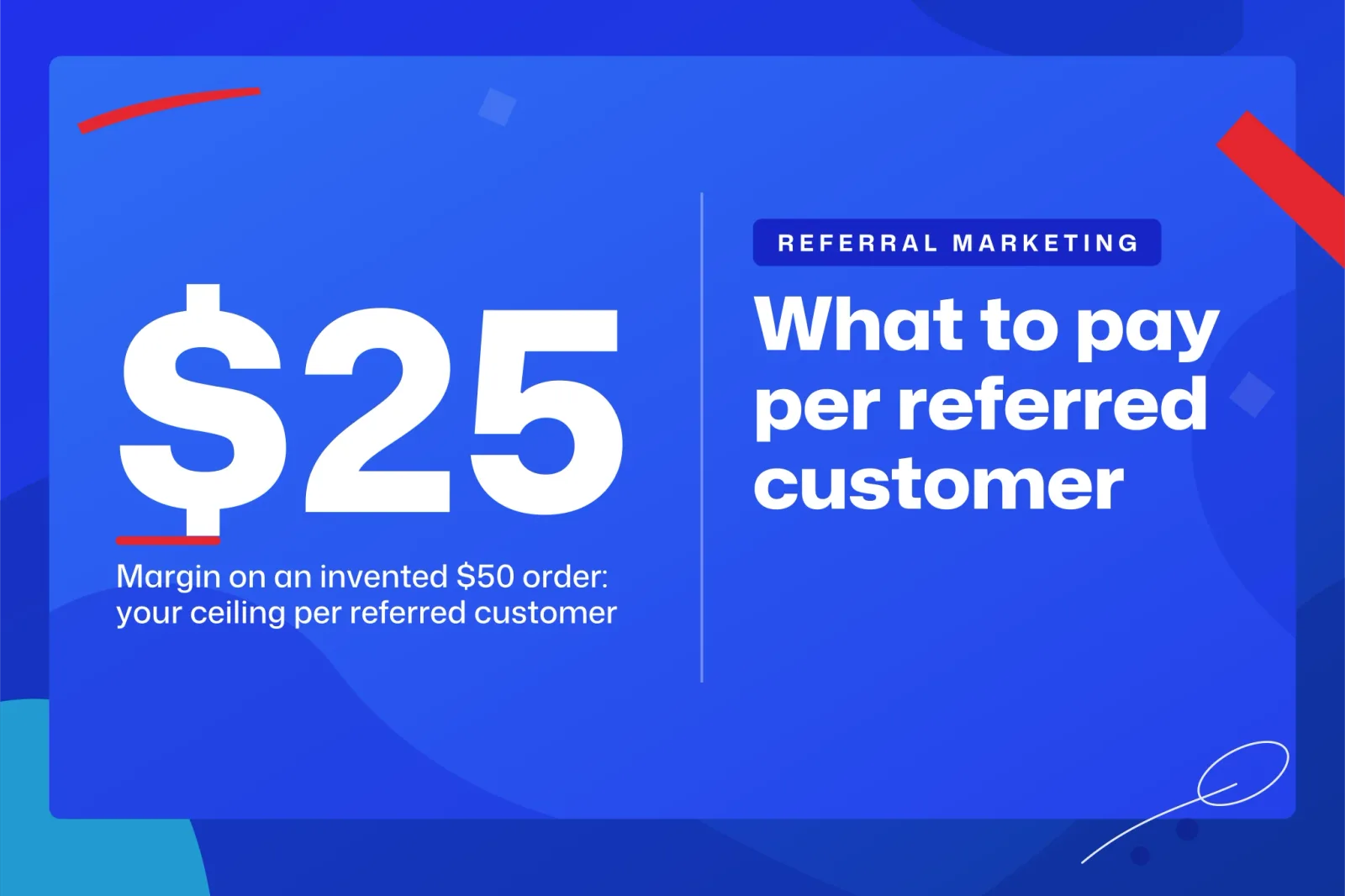
All figures in this section are invented. Take an average order of $50 with $30 in product cost, which leaves $20 of gross margin, or 40%. The reward is $10 for the person who invites. Two variables decide the result: how much of the credit or discount actually gets used, and what share of referred orders is incremental, meaning it would not have arrived without the program. Taxes and gateway fees are left out so the math stays clean; in your store, subtract them from the margin.
| Starting data | Value |
|---|---|
| Order price | $50 |
| Product cost | $30 |
| Gross margin | $20 (40%) |
| Reward for the person inviting | $10 |
| Store credit redeemed | 70% |
| Discounts used | 40% |
| Incremental referred orders | 50% |
Step 1: expected cost per referred order. Cash is always paid, so it costs $10. Store credit costs $10 × 70% = $7. The discount costs $10 × 40% = $4.
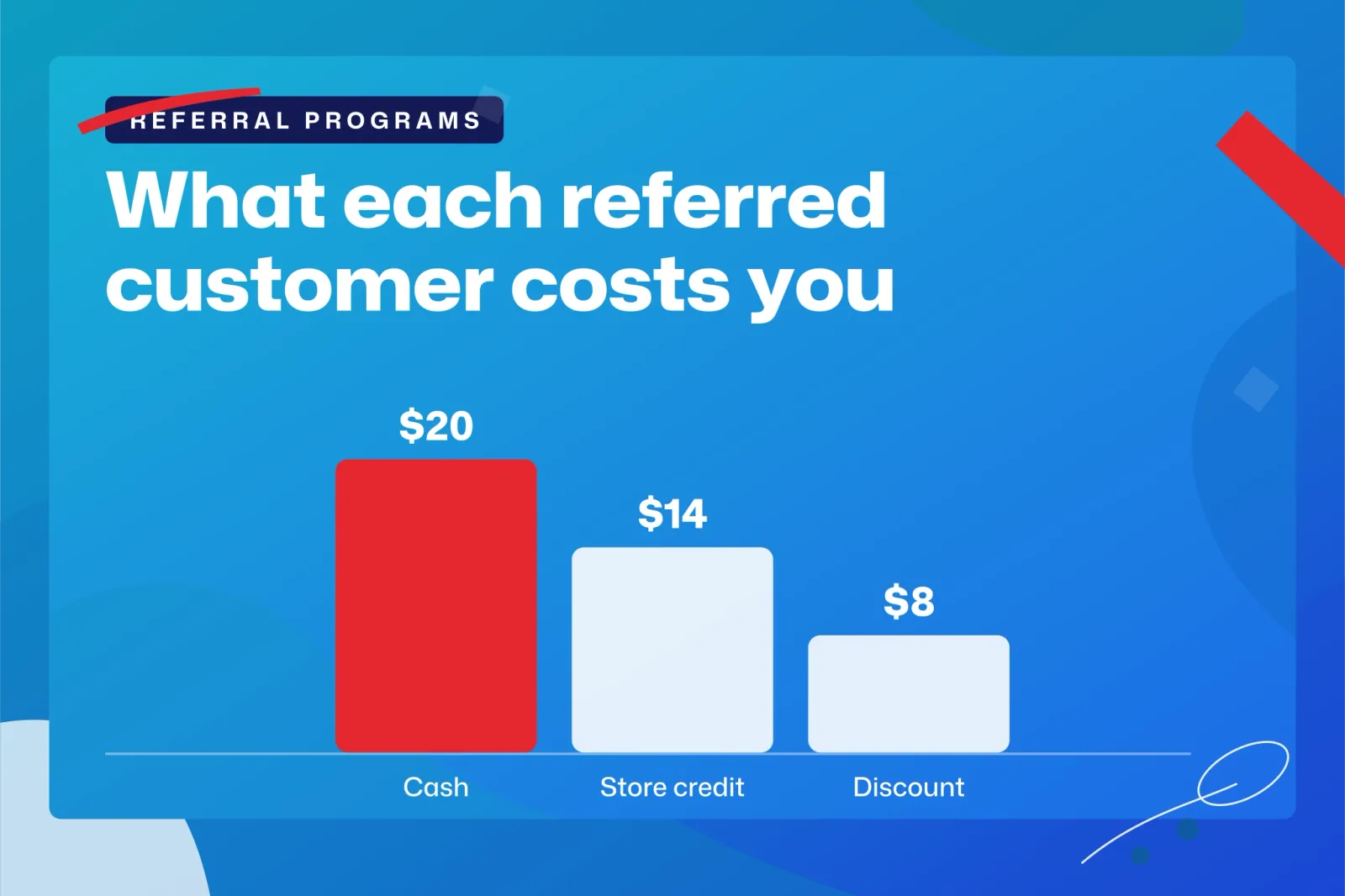
Step 2: cost per incremental customer. If half the referred orders would have arrived anyway, you pay two rewards for every customer the program really brings. Divide by 0.5 and you get $20 with cash, $14 with store credit and $8 with the discount.
Step 3: compare it with the margin on the first order. With cash, the $20 cost eats the whole $20 margin and the new customer nets you zero on their first purchase. With store credit you keep $6; with the discount, $12.
Step 4: break-even point. The share of referred orders that must be incremental so you do not lose money on the first order is the expected cost divided by the margin: 10 / 20 = 50% with cash, 7 / 20 = 35% with store credit and 4 / 20 = 20% with the discount.
| Reward | Expected cost per referred order | Cost per incremental customer | Margin left from the first order | Minimum incrementality |
|---|---|---|---|---|
| Cash | $10 | $20 | $0 | 50% |
| Store credit | $7 | $14 | $6 | 35% |
| Next-order discount | $4 | $8 | $12 | 20% |
The double reward is where most margin leaks. If you give $10 in cash to the person who invites and a $10 discount to the invited person on their first purchase, each referred order costs $20. With half the orders incremental, each new customer costs $40 and you lose $20 on their first order. To break even you would need every referred order to be incremental, which does not happen.
Store credit has one point in its favor that the table does not capture. If the customer spends it on a unit they would not otherwise have bought, it costs you the cost of that product, not its price. We counted it in full because that is the cautious case.
The first order is not everything either. If the new customer reorders, the margin on those purchases also pays for the reward, and how much you can spend to acquire a customer without losing money shows how to add that up. But if the math only works by assuming repeat purchases you have not measured, the reward is too high.
How do you choose the reward based on your margin and repurchase rate?
Choose with two data points: how much margin your average order leaves and how often a customer comes back. Store credit and discounts are only worth something to people who plan to return. For someone who buys once every few years they are empty rewards, and nobody invites for an empty reward.
| Your store | Reward that makes most sense | Why |
|---|---|---|
| High margin, frequent repurchase (coffee, cosmetics, consumables) | Store credit | The customer will use it and values it, and it only costs you when they return |
| High margin, one-off purchase (furniture, electronics) | Cash, or an immediate discount for the invited person | Credit does not motivate someone who will not come back, and the margin can absorb always paying |
| Low margin, frequent repurchase | Next-order discount with a minimum order | It is the cheapest and it is paid for by a new purchase |
| Low margin, one-off purchase | No monetary reward | Any reward large enough to motivate eats the margin |
For that last case there are routes without a monetary reward, which we cover in the word of mouth marketing strategy for ecommerce.
Can you require a minimum order without hurting usage too much?
Yes, if you set it slightly above your average order. A minimum order reduces how many customers use the reward and raises the margin on those who do. For example, a $10 discount with a $60 minimum order and a 40% margin leaves $24 of margin before the discount and $14 after it. If the minimum forces people to spend far more than usual, almost nobody reaches it and the person inviting stops seeing the reward as real.
How do you compare the cost of a referral with the cost of a customer from ads?
Calculate the program's cost per incremental new customer and set it next to the acquisition cost of your ads, using the same period and the same definition of new customer. The program's cost is everything it cost you in the month, meaning cash paid, credit redeemed, discounts used and the app fee, divided by the new customers who would not have arrived without it. For example, $300 of total cost and 20 incremental customers gives $15 per customer.
The ads side is calculated as explained in how to calculate customer acquisition cost, first-order discount included. If today you mostly look at ROAS, read how ROAS and customer acquisition cost differ first, because a referral program has no ROAS and the comparison only works in cost per customer.
The hard part is the denominator: knowing how many customers are incremental. There is no exact method, but three checks help:
- Exclude people who were already customers. If the invited person's email already has orders, they are not a new customer and should not trigger a reward.
- Look at the store's total new customers, including those who arrive without a code. If referrals go up and the store's new customers do not, the program is labeling sales you already had as referrals.
- Watch where the codes circulate. A referral code posted on a coupon site attracts people who do not know the person inviting; those orders are discounts, not recommendations.
If you cannot estimate incrementality, run the example math with several assumptions and find the one where it stops being profitable. If the program only works under the most optimistic assumption, lower the reward.
Referral program FAQ
Do you need an app to run a referral program on Shopify?
Not at the start. You can create one discount code per inviting customer and note in a spreadsheet who buys with each. Once volume makes the sheet slip out of your control, a referral app automates the links, the tracking and the delivery of rewards.
What happens if the referred customer would have bought anyway?
You pay the reward without gaining a customer. That is why the real cost is divided by incremental customers and not by all referred orders. Requiring the invited person to be a new customer and not publishing the codes reduces those cases, though it does not remove them.
When should you give the reward to the person who invites?
When the invited person's order can no longer be returned. If you give it earlier, a return leaves you with the reward paid and no sale.
What if the referral is a group purchase?
Group buying is a referral where the reward is the price itself: the discount only exists if another person joins. With Tuko, the store chooses the products and the discount, and a group buy button appears on the product page. The customer pays with the discount already applied at the store's normal checkout and has 24 hours, or 48 if the store chooses, for another person to join, for example by sharing their link on WhatsApp. Each order is individual and ships to each customer's own address. If you want to see how this differs from Groupon-style coupons, we explain it in what group buying is.
Compared with the rewards in the example, it changes the weak point that costs the most margin. A regular discount is also taken by people who were going to buy anyway; with Tuko, nobody gets the lower price without bringing in another customer. There are no pending balances and no payments outside Shopify either. If the group does not fill, the customer chooses between keeping the missing units at the group price, moving to another open group for the same product or getting their money back, and if they do not answer within 12 hours they are refunded automatically. The order is not shipped until the group is complete.
It has limits, and you should still do the math. The discount applies to both orders, so treat it as a double reward: compare the discount on both with the margin the second person leaves when they would not have come alone. And choose the mode carefully. With “Friends first”, at the start only people who receive the first buyer's link can join, and the group opens to everyone in the last 6 or 12 hours. With “Any customer”, any visitor can join from the start; the logical expectation is that groups fill more easily, but the second person may be someone who was already going to buy, and that brings you closer to an open discount. To see how this fits with the rest of your store's discounts, there is the math on every discount's effect on conversion and margin.
Your next step is to work out the margin on your average order and redo the example table with your own data: if the break-even point of the reward you had in mind needs more than half of referred orders to be incremental, lower it or switch to store credit. If you want to test group buying alongside it, install Tuko from the Shopify App Store: it takes about two minutes, you do not have to touch your theme and you do not need Shopify Plus.