Written with artificial intelligence by Tuko's editorial system, from the sources linked below. If you spot a mistake, write to joan@tukoteam.com.
How referral marketing works in ecommerce, and how much you can pay per customer without losing margin
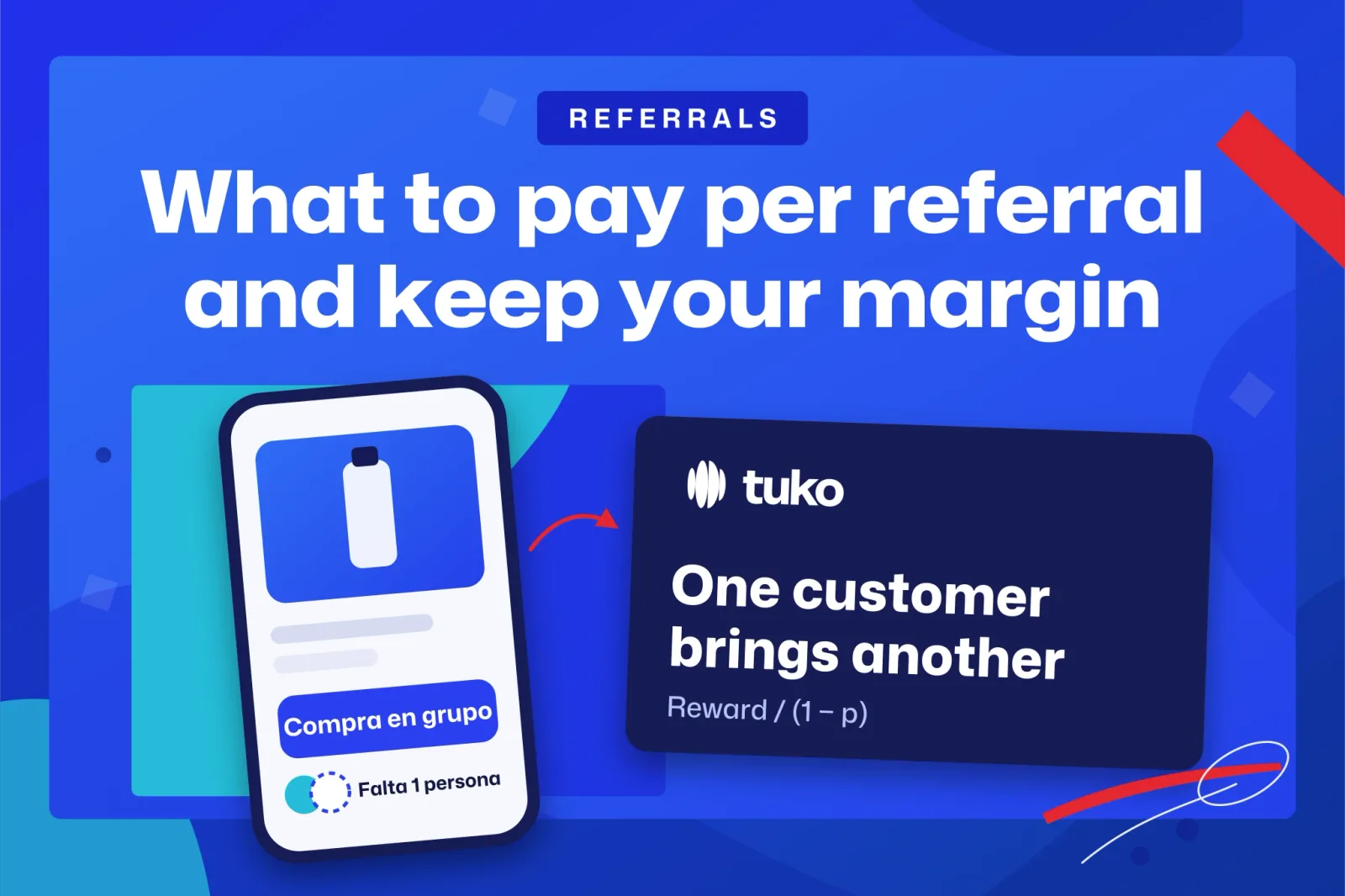
In ecommerce, referral marketing works like this. A customer recommends your store with their own link or code, the person they send places an order, and you reward one of them or both, usually with a discount. Whether it pays off depends on a calculation few stores do: the reward has to fit inside the order's margin, and you have to subtract the referred buyers who would have ordered anyway. If you already know what a customer costs you through ads, you have your benchmark in the guide to calculating break-even ROAS.
What referral marketing is
Referral marketing is a system that rewards a customer for bringing in another customer. It is word of mouth with an incentive and tracking on top. The recommendation still comes from a real person, but the store gives them a reason to make it, records it and decides when to pay.
People often mix it up with affiliate marketing. In a referral program the person recommending is a customer, and they get a discount, a product or store credit for their next order. In affiliate marketing the recommender earns a commission, and it is usually a website or a creator who may never have bought from the store.
Trust explains why it works at all. In Nielsen's 2021 Trust in Advertising survey, run online with more than 40,000 consumers, 88% said they trust recommendations from people they know more than any other channel. That figure measures stated trust, not purchases. Trusting a friend does not mean someone will buy through their link.
How a referral program works, step by step
A referral program has five parts, and it is worth deciding all of them before launch.
- Unique link or code. Each customer gets their own to share. That is how you know who brought whom.
- Tracking. When the friend arrives through that link or uses that code, the order is attached to the customer who recommended it.
- Conversion rule. You define what counts as a valid referral: a new customer, a minimum order value, no return.
- Reward. It can go only to the referrer, only to the friend or to both, which is usually called a double-sided reward. Common forms are a discount, a free product or credit toward the next order.
- Payout timing. You can pay the reward as soon as the friend orders or once the return window closes. The earlier you pay, the easier it is for abuse to slip through.
The conversion rule moves the result more than any other part. With a loose rule, the program ends up as one more discount, used by people who were already customers.
Do referral programs actually work? What the data says
Yes, with caveats most guides leave out. One study that measures it rigorously is by Schmitt, Skiera and Van den Bulte, published in the Journal of Marketing in 2011. They tracked about 10,000 customers of a German bank for almost three years: all 5,181 customers the bank acquired through its referral program in 2006 and a random sample of 4,633 acquired through other channels, observed over 33 months.
These are the main findings of the paper by Schmitt, Skiera and Van den Bulte:
- A referred customer is worth on average at least 16% more than a non-referred customer with similar demographics and time of acquisition, according to the 2011 study by Schmitt, Skiera and Van den Bulte.
- Referred customers stay longer. According to the Journal of Marketing paper, they are approximately 22% less likely to leave within the first 21 months.
- Their margin advantage fades. It starts out sizable and erodes to zero after approximately 1,000 days, as the same study reports.
- The program paid off less when used to acquire older or low-margin customers.
In euros, the bank's case looked like this. A referred customer was worth 40 euros more (16%) over the six years after acquisition, and the reward paid to the referrer was 25 euros. The authors translate that into a return on investment of approximately 60% over six years, according to the Journal of Marketing study. Look at the time frame. The reward was paid up front and earned back over years.
The most useful finding for a store is a different one. The authors conclude that referral programs help a company selectively acquire people who were already promising prospects, and that the program itself does not turn unattractive prospects into valuable customers. Their recommendation is to target referral programs selectively.
The study's limit is obvious. It is a bank, with customers who stay for years and a customer value unlike anything an online store order generates, so its percentages do not carry over to Shopify. The method does carry over. It compares the reward with the value a customer generates over time instead of with their first order.
How much you can pay per referral based on your margin
The largest reward a first order can absorb is its gross margin minus what it costs you to fulfill it. Gross margin is order value times your margin percentage, and from that you subtract the shipping you cover and the payment fee. If the reward fits there, the first order pays for it. If it does not, it only pays off when the customer buys again, and then you have to compare it with the margin they leave over their lifetime, the way the bank study does.
All figures in this section are invented. The usual mistake is to think about the reward as a share of order value. A 15% reward sounds reasonable, but 15% to each side means giving away 30% of the order, and with thin margins that is nearly all of it. Take a $60 order, $4 of shipping and payment fees paid by the store, and a 15% reward for each side: $9 off for the friend and $9 of credit for the referrer, $18 in total.
| Gross margin | Margin on a $60 order | After $4 of shipping and payment | Total reward | What's left |
|---|---|---|---|---|
| 30% | $18 | $14 | $18 | −$4 |
| 40% | $24 | $20 | $18 | $2 |
| 60% | $36 | $32 | $18 | $14 |
At a 40% margin, the reward eats $18 of the $24 margin, 75% of the first order's margin, and after shipping you keep $2. At 30% you lose $4 on every referral. At 60% the first order covers the reward comfortably.
A negative number does not rule the program out. In the 30% case, a second $60 order at full price leaves $14 and covers the $4 you lost, so the decision depends on how many of your referred customers buy again, and only your own data can tell you that. That $18 is the cost to set next to what a customer costs you through ads, and the real cost is higher because of referred buyers who would have ordered anyway.
What each new customer really costs when some referrals would have bought anyway
The real cost of a referred customer is the reward divided by the share of referrals who would not have bought without the program. As a formula, cost per incremental customer = reward / (1 − p), where p is the share of referred buyers who would have bought anyway. You pay all of them, and only some are customers you would not otherwise have.
The p value covers the friend who already knew the brand and had it on their wish list, the existing customer who comes back with someone else's code, and the self-referrer who recommends themselves with a second email address. There is no reliable public figure for p in ecommerce, so each store has to estimate its own.
All figures in this section are invented. With an $18 reward per referral and p at 30%, if 100 referred customers place an order you pay $1,800 in rewards and only 70 of them are genuinely new. Each one costs you $1,800 / 70, about $25.70, instead of $18. With p at 50%, the cost rises to $36.
If your store has many repeat customers or a community that already talks about you, p is probably high. Seasonal discounts have the same problem, since they go to people who were going to buy regardless, and we work through the numbers in how much discount to offer on Black Friday without losing margin, with cannibalization counted.
What you can restrict in Shopify to limit referral abuse
Abuse is the other cost of a referral program. Schmitt, Skiera and Van den Bulte point out that in most referral programs the reward is paid regardless of how long the referred customer stays, which makes these programs prone to abuse, and that the company needs a way to check that a referred customer is actually new rather than an existing or former one.
If you run referrals with Shopify discount codes, Shopify's help page on discount code usage limits lists these native restrictions:
- How many times the code can be used in total.
- One use per customer. That limit applies only to that specific discount: if you delete it and duplicate it, someone who already used it can use it again.
- A minimum order amount before the code can be used.
- Restricting the code to specific customers, products and variants, up to 100.
Those options stop a code from spreading unchecked, but they leave out the two things a referral program needs most. Our reading of that page is that it describes no "first purchase only" condition and no way to see which customer referred whom, so for that you will need an app from the Shopify App Store or a manual check of orders.
Referral program, store-wide discount or group buying
All three lower the price. They differ in who gets the lower price and when you pay for it. A store-wide discount goes to every buyer. A referral program pays for a customer who may not be incremental. With group buying, the lower price applies only if another person joins. Tuko, which publishes this blog, is a group buying app for Shopify, so we have a stake in this comparison.
| Criterion | Store-wide discount | Referral program | Group buying (Tuko) |
|---|---|---|---|
| Who gets the lower price | Any buyer | The referrer, the friend or both, depending on the program | Buyers in the group, and only if the group fills |
| When you pay | On every order that uses the discount | When the referral meets the rule: an order, a minimum spend or the end of the return window | At checkout, with the discount applied; the order does not ship until the group is complete |
| Risk of paying without gaining a new customer | High: it goes to people who would buy anyway | Medium: friends who already knew the brand, existing customers and self-referrals | The lower price requires another person to join; in "Any customer" mode that person may have been about to buy anyway |
| What you need to install | Nothing, it is a Shopify discount | A referral app or manual code checks | The Tuko app: about two minutes, no theme edits, no changes to payment settings and no Shopify Plus required |
Tuko adds a group buying button to the product page. The customer pays with the discount already applied in the store's normal checkout and has 24 hours, or 48 if the store chooses, for another person to join. To make that happen they share their link, for example on WhatsApp. Each order is individual and ships to each customer's own address. If the group does not fill, the customer chooses between keeping the missing units at the group price, moving to another open group for the same product or getting their money back, and if they do not reply within 12 hours they are refunded automatically.
If your worry is rewards going to people who would have bought anyway, the mode you pick is what matters. In "Friends first", the recommended mode, only people who receive the first buyer's link can join at first, and the group opens to all visitors in the last 6 or 12 hours. In "Any customer", any visitor can join from the start, and the second buyer may be someone who was already going to buy. The full mechanism is in what group buying is and how it differs from Groupon, and the comparison with other seasonal discounts is in which Black Friday discounts bring in new customers and which ones just give away margin.
How to start a referral program in a Shopify store
- Choose who gets the offer. In the German bank study the program paid off less with low-margin customers, and the authors recommend a selective approach. In a store, the sensible starting point is customers who already buy repeatedly and your highest-margin products.
- Set the reward against margin. Run the gross margin minus shipping and payment calculation with your own numbers, and decide whether the first order has to cover the reward or whether you are counting on repeat purchases.
- Write down the rules. New customers only, a minimum order, one use per customer, and the referrer's reward paid once the return window closes.
- Decide how to build it. Native discount codes let you test on a small scale; to track who referred whom you will probably need an app from the App Store.
- Measure incremental customers. Count how many referred buyers were already customers or already on your email list before using the code. That share is your p, and with it you know what each new customer really costs.
Before choosing a system, run the margin calculation with your own numbers, because it sets the discount you can afford in any of them. If you want to test a mechanism where the lower price applies only when another person joins, you can install Tuko from the Shopify App Store and turn it on first for your highest-margin products.