Written with artificial intelligence by Tuko's editorial system, from the sources linked below. If you spot a mistake, write to joan@tukoteam.com.
How to calculate customer acquisition cost for your Shopify store, first-order discount included
To calculate customer acquisition cost (CAC), add up everything you spent to win customers in a period and divide it by the new customers you got in that same period. CAC is what it costs you, on average, to get someone who has never bought from you to place a first order. Two details separate a useful CAC from a misleading one: which costs go on top, and who you count underneath.
This article is about how much you really spend. If you want to know the most you could spend, that is in how much you can spend to acquire a customer without losing money. The two numbers work together.
What is the customer acquisition cost formula?
The CAC formula is: total acquisition spend in the period ÷ new customers in the period. It is the standard definition, as in Wikipedia's entry on customer acquisition cost. Both parts have to cover the same dates.
A new customer is someone who places their first order in your store within that period. If someone first bought last year and comes back this month, that counts as an order, not as a new customer.
For a store with steady sales, the calendar month works well: it lines up with the invoices from your agency, your tools and your ads. With few sales, a single month swings a lot on a couple of orders; quarters or a 90-day rolling average work better there.
Which costs should you include in CAC?
CAC includes every cost whose purpose is to win someone who is not a customer yet. Ads are the visible part; what usually gets forgotten is everything around the ads and the discount you give to close the first purchase.
| Cost | Part of CAC? | Why it gets missed or mixed up |
|---|---|---|
| Meta Ads, Google Ads, TikTok and other ads | Yes | It is the only thing many people count |
| Creative: photos, videos, creator content | Yes | It is paid separately and filed as "design" |
| Acquisition agency or freelancer | Yes, the share spent on acquisition | If they also email existing customers, that share is not |
| Acquisition tools (pop-ups, landing pages, ad analytics) | Yes, the proportional share | They sit on the card as "software" |
| Influencers: fee, product and shipping | Yes | Gifted product is forgotten because there is no invoice |
| First-order discount | Yes, or in the margin, never in both | It never leaves the bank: it is money you do not collect |
| Your own time, or the salary of whoever runs marketing | Optional, but worth knowing | If you do it yourself, your CAC looks lower than it is |
| Shopify plan, order shipping, product cost | No | They are costs of selling and belong in the per-order margin |
Salary is the most debatable line. If you run the ads yourself, putting your time into CAC tells you what acquisition would cost if you handed it over tomorrow. Work it out with and without that line and keep both numbers.
Does the first-order discount count as an acquisition cost?
Yes. The welcome discount, the pop-up code or the abandoned-cart email discount given to a new customer is money you hand over so that someone buys for the first time. If you leave it out, a store that acquires with aggressive discounts looks cheaper than it is.
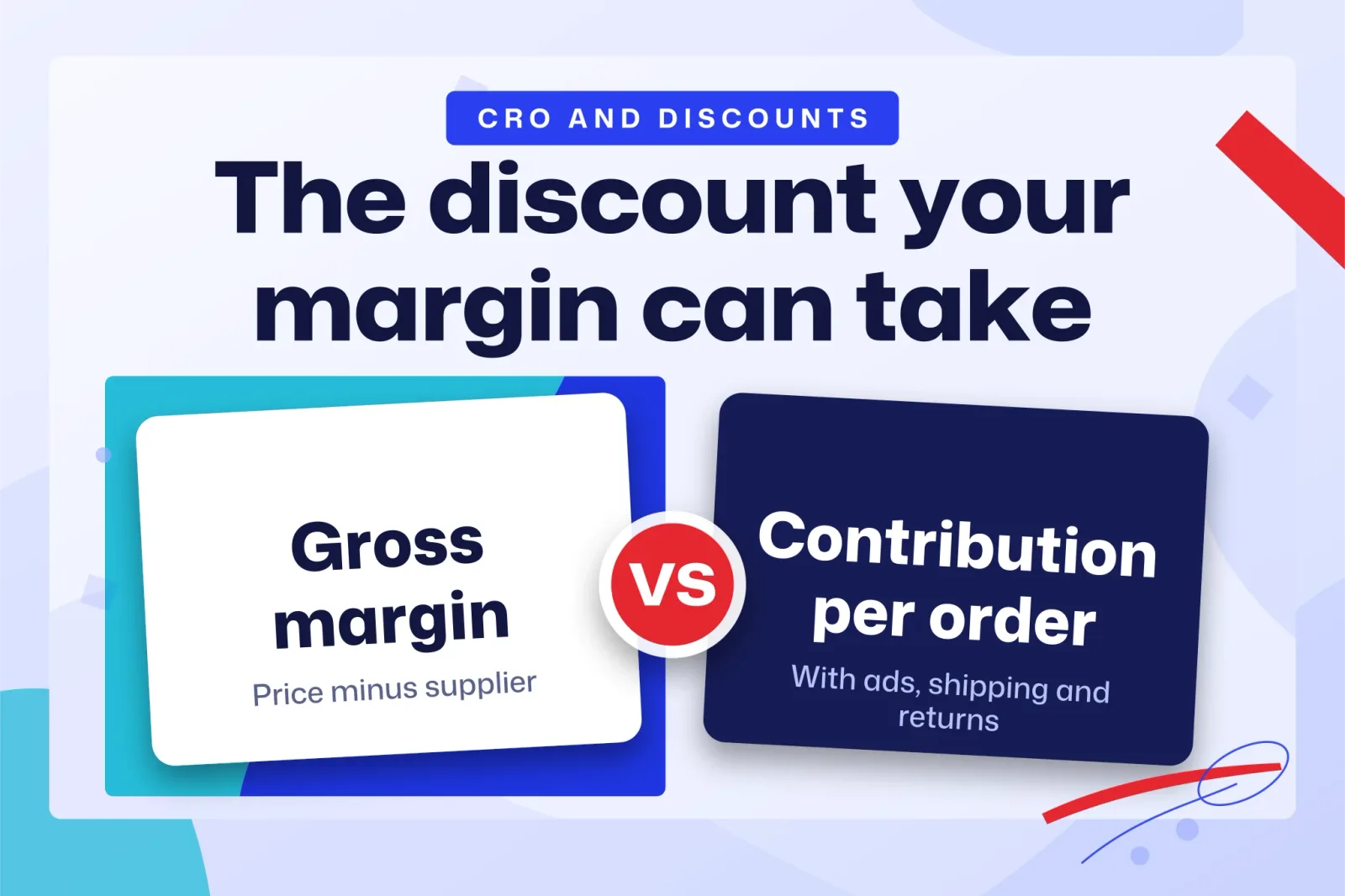
The only rule is not to count it twice. You can put it in CAC and work out first-order margin at full price, or leave it out of CAC and subtract it from margin. The end result is the same, as the example below shows. What breaks the numbers is putting it in both places, or in neither.
Recovery emails work the same way: part of that discount goes to people who were going to buy anyway. We go through the numbers in how to recover abandoned checkouts on Shopify and when the email discount costs you margin.
Why divide only by new customers?
You divide only by new customers because acquisition spend exists to bring them in. If you divide by every order in the month, returning customers, who would have come back without that spend, push CAC down artificially.
The effect grows with loyalty. The more repeat orders you have, the further "spend divided by orders" drifts from the real cost of winning someone new. A consumables store with lots of repeat orders can believe it acquires cheaply just when its acquisition is getting more expensive.
To separate new from returning customers, the most reliable starting point is each customer's first order date. Shopify's analytics include customer reports (see Shopify's help page on customer reports); if yours splits first-time from returning customers, use it and check that it filters on the same dates as your spend. Otherwise, export your orders, group them by customer email and mark as new anyone whose first order falls inside the period. Guest checkouts with different emails can inflate new customers slightly; at normal volumes the error is small.
Example: a Shopify store's real CAC in one month
Every figure in this section is made up. A Shopify store closes the month with 500 orders. Of those, 200 come from new customers and 300 from customers who had bought before. The average order is $50 before discounts.
The month's acquisition spend looks like this:
- Meta Ads: $3,000
- Google Ads: $1,500
- Creative: $600
- Ads agency: $800
- Acquisition tools, proportional share: $100
- Influencers, product and shipping: $300
- 10% welcome discount: used by 160 of the 200 new customers, at $5 each, $800
The total is $7,100. Spread over 200 new customers, the real CAC is $35.50.
Now the usual shortcuts, with the same store:
- Ads only, divided by all orders: $4,500 ÷ 500 = $9.
- Ads only, divided by new customers: $4,500 ÷ 200 = $22.50.
- The CPA Meta shows: it credits itself with 150 purchases for its $3,000, so $20.
- The CPA Google Ads shows: it credits itself with 90 conversions for its $1,500, about $16.67.
The two platforms add up to 240 attributed purchases when there were only 200 new customers. Together they give a CPA of $4,500 ÷ 240 = $18.75, about half the real CAC.
| Calculation | Numerator | Denominator | Result |
|---|---|---|---|
| Ads ÷ all orders | $4,500 | 500 orders | $9.00 |
| Combined platform CPA | $4,500 | 240 attributed conversions | $18.75 |
| Ads ÷ new customers | $4,500 | 200 new customers | $22.50 |
| Without the discount ÷ new customers | $6,300 | 200 new customers | $31.50 |
| Real CAC | $7,100 | 200 new customers | $35.50 |
The next question is whether that CAC holds up. Say that after product, shipping, payment fees and returns, each $50 order at full price leaves $20 of contribution margin. Since the discount is already inside CAC, the first order is compared at full price: $20 − $35.50 = −$15.50 per new customer. The store loses money on the first purchase and gets it back from the second order onwards: with two orders, $40 − $35.50 = $4.50.
If you would rather leave the discount out of CAC, the calculation changes shape but not result. CAC drops to $31.50. The average discount per new customer is $800 ÷ 200 = $4, so the first order leaves $16 of margin. And $16 − $31.50 = −$15.50, the same. If you put it in both places, you would get $16 − $35.50 = −$19.50, a $4 error per customer.
Why doesn't my CAC match the CPA in Meta or Google Ads?
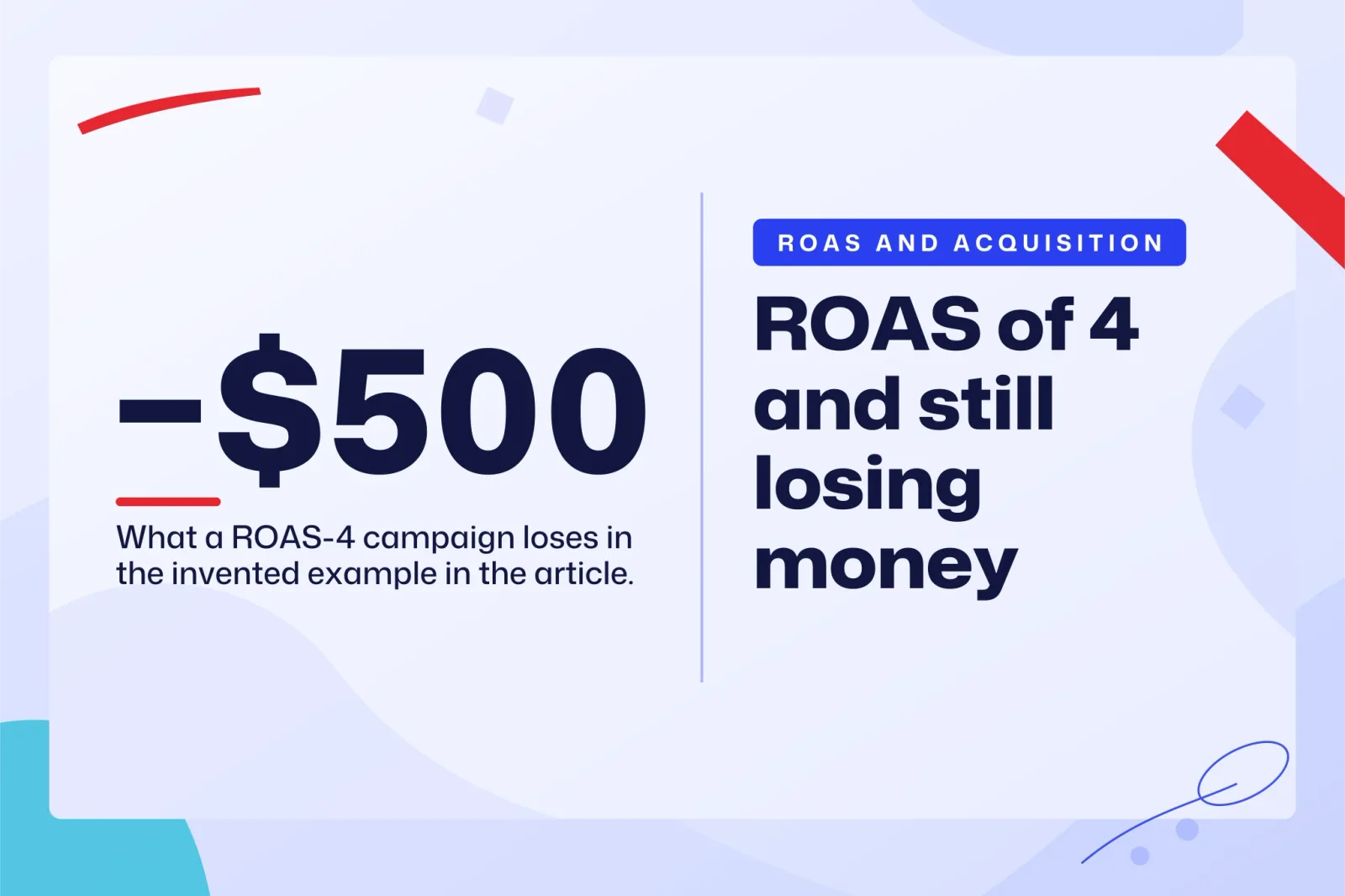
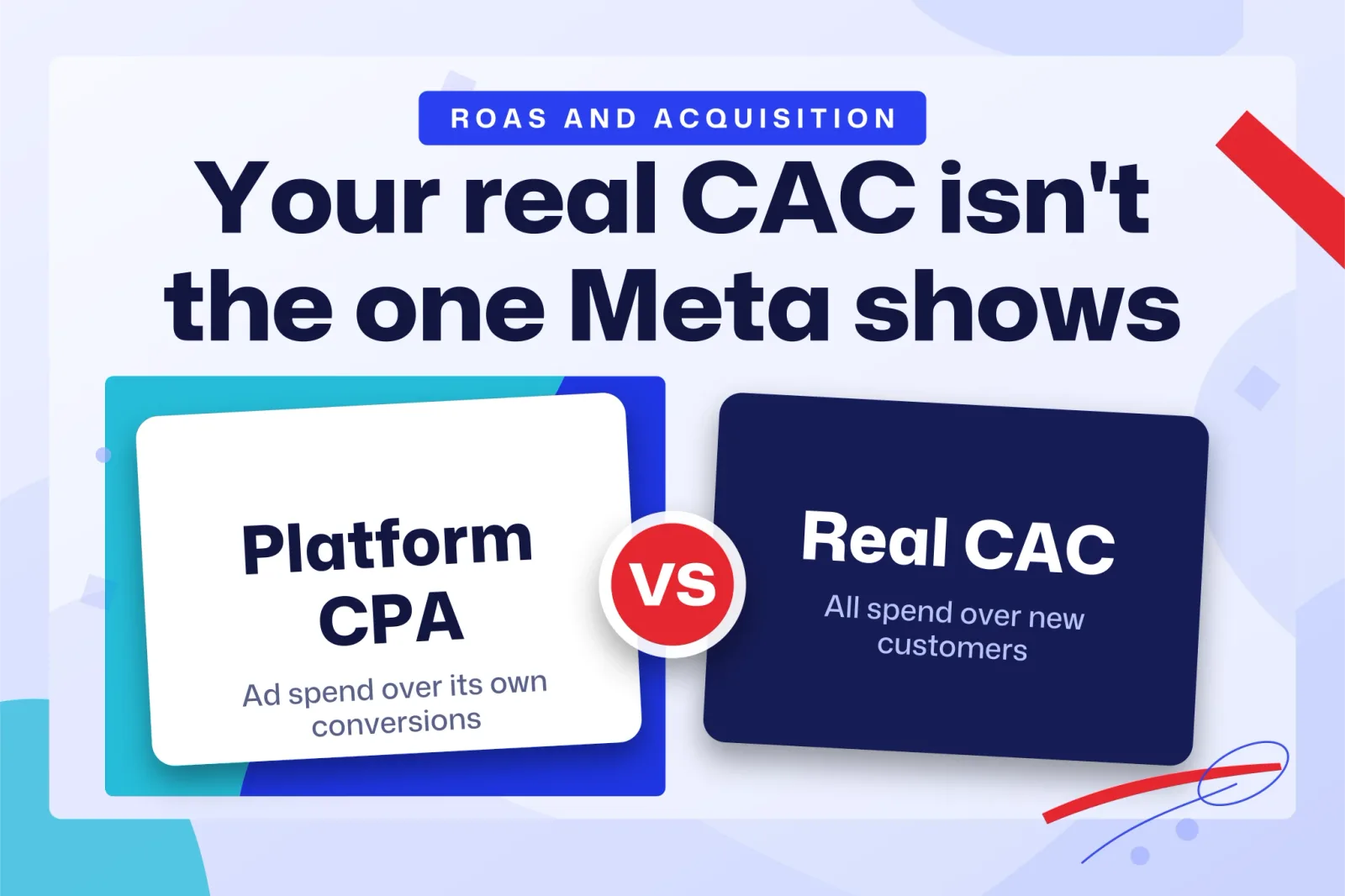
Your CAC and each platform's CPA don't match because they measure different things. CPA divides that platform's ad spend by the conversions it credits itself with; CAC divides all your acquisition spend by the new customers who actually came in.
Three reasons almost always explain the gap:
- Each platform counts purchases, not new customers. Unless you set it up otherwise, a returning customer who buys after a remarketing ad also counts as a conversion.
- Attribution overlaps. Each platform applies its own model and attribution window, so someone who saw an ad on Instagram and then searched for your brand on Google can end up counted by both. Check which window each account is set to before comparing.
- The numerator is smaller. CPA only includes what you pay the platform, without creative, agency or discounts.
CPA is still useful for deciding where to move budget inside a platform: which campaign or ad performs better than another. To know whether acquisition is profitable, the number that matters is blended CAC.
How do you know if your CAC is too high?
Your CAC is too high when it exceeds the margin a new customer leaves you within the time you can afford to wait. If you sell something people buy once, the first order has to cover CAC. If you sell consumables that get reordered, you can lose money on the first order as long as you know, from your own data, how many orders an average customer places and over how many months.
With tight cash flow, waiting until the third purchase to earn back what you spent is a risk even if the numbers work over a year. The prudent move is to set a payback period your cash can handle and compare CAC with the margin accumulated within it.
The limit itself is worked out in how much you can spend to acquire a customer, calculated from your margin. If you work with ROAS in your ads manager, how to calculate break-even ROAS and how much each discount raises it turns that same limit into the number you see in Meta.
How do you lower CAC without relying only on ads?
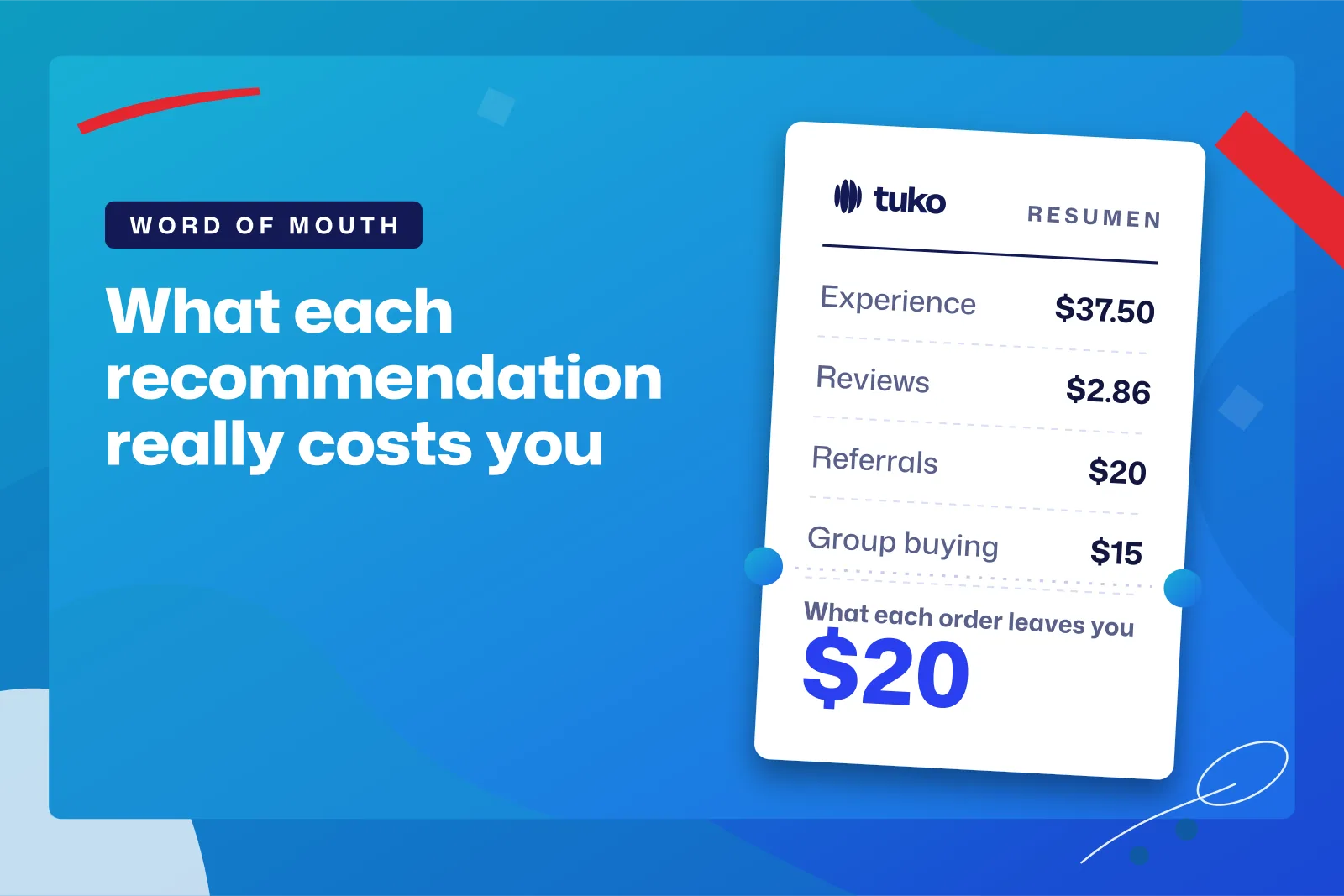
To lower CAC without relying only on ads, you need channels where the cost only appears when a new customer arrives. With ads you pay for impressions or clicks whether anyone buys or not; with a referral programme you pay the reward when the referred person buys. That turns a fixed, uncertain cost into a variable one.
Word of mouth and referrals fit there. The word-of-mouth marketing strategy and how referral marketing works calculate how much you can pay for each customer brought in without losing margin, using the same logic as this article.
Group buying is another way to tie the discount to a customer who actually arrives. With the group buying that Tuko adds to the Shopify product page, the lower price only applies if one more person joins: the first buyer shares their link, for example on WhatsApp, and both get the discount when the group is complete. Nobody gets that price without bringing another customer, unlike a welcome code that anyone who finds it can use.
It has a limit worth measuring: whoever completes the group may already be one of your customers. That is why the group-buying discount goes into the calculation like any other, and you only divide by the buyers who were genuinely placing their first order.
Frequently asked questions about customer acquisition cost
Can you calculate CAC by channel?
You can, but carefully. CAC by channel depends on how you attribute each new customer to a channel, and that is where the platforms' overlaps come back. Use it to compare channels with each other, and always keep the store-wide blended CAC next to it.
What is the difference between CAC and CPA?
CPA is the cost per acquisition or conversion that each ad platform calculates from its spend and the conversions it credits itself with. CAC is your own calculation: all acquisition spend divided by real new customers. CPA is for optimising campaigns; CAC is for knowing whether acquisition pays.
How often should you recalculate CAC?
Once a month is enough for most stores, once all the invoices for the period are in. If you change the budget a lot or launch a new discount, recalculate when that push ends to see its effect on its own.
What to do with your CAC now
Open a spreadsheet with your last closed month. Write down every cost from the table above, including the first-order discount, count only customers whose first order falls in those dates, and divide. Put the result next to the CPA in Meta and Google Ads and next to the contribution margin of your average order. If your real CAC is higher than that margin and your customers are slow to reorder, look for channels where the discount is only paid when someone new arrives; one of them is to install Tuko on your Shopify store and try group buying on a couple of products.