Written with artificial intelligence by Tuko's editorial system, from the sources linked below. If you spot a mistake, write to joan@tukoteam.com.
How much you can spend to acquire a customer without losing money, worked out from your margin
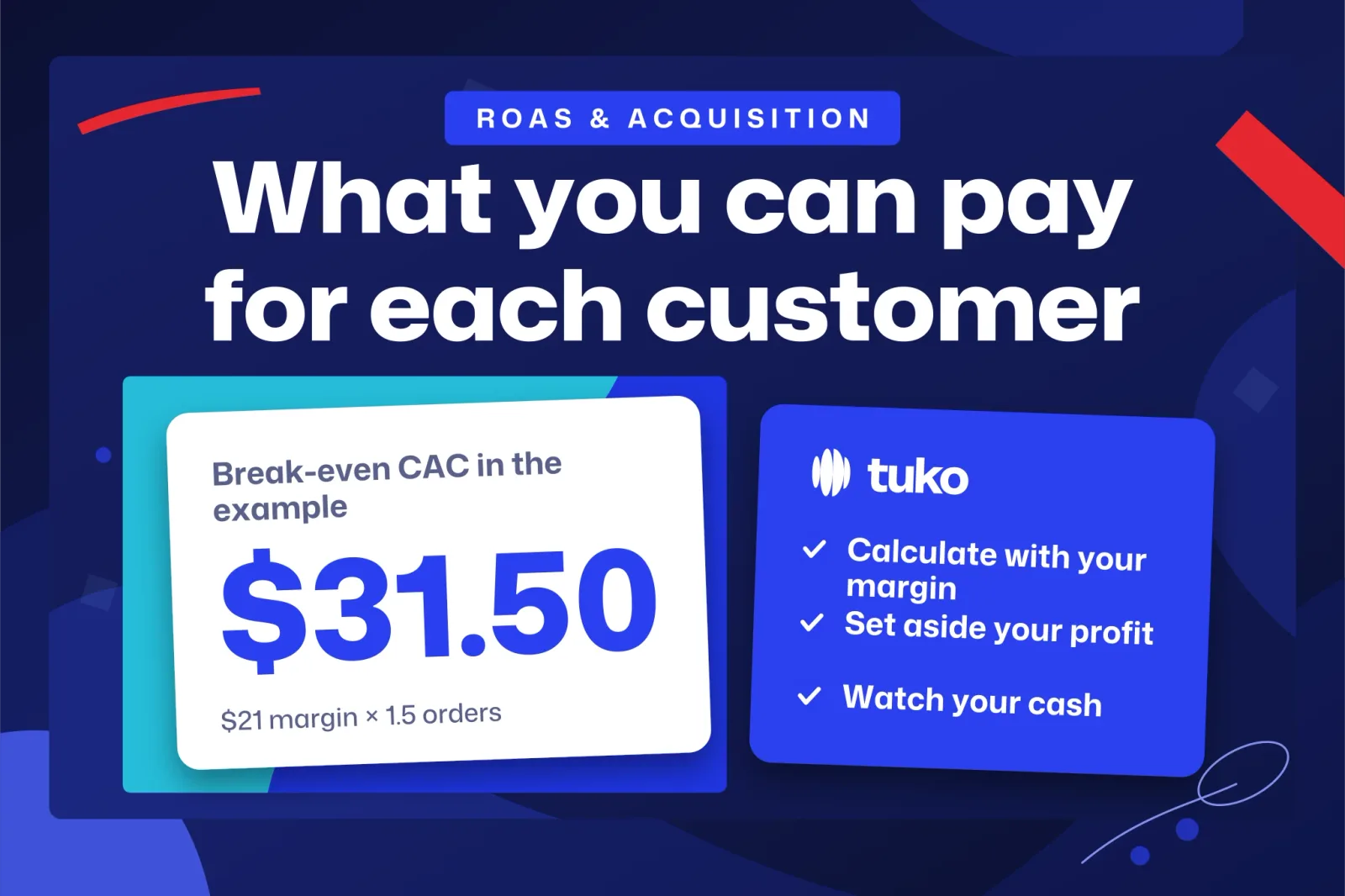
The most you can spend to acquire a customer is the contribution margin that customer leaves you across all their orders: margin per order multiplied by the number of orders you expect them to place. Spend above that and every new customer loses you money; spend below it and the gap is your profit. Once you have that ceiling, the next step is to work out the break-even ROAS for each campaign.
How much you can spend to acquire a customer, in one formula
Break-even CAC, the most you can pay for a customer without losing money, fits on one line:
Break-even CAC = contribution margin per order × expected orders per customer
For example, with an average order of $60 before sales tax and a 35% contribution margin, each order leaves you $21. If each customer places 1.5 orders, you can pay up to $31.50 to acquire them and still break even.
That number is the ceiling, with zero profit. What you should actually pay sits below it, and the calculation to set it comes further down. The formula uses margin rather than revenue on purpose. The rules of thumb that get passed around, such as the 10% of LTV proposed on Shopify's Spanish-language blog (Juan Merodio, 2020) or the 3:1 ratio that Shopify's English blog (Azra Kassam, 2026) calls the sweet spot, give very different limits depending on the base you apply them to.
What CAC is and how to calculate yours
CAC, customer acquisition cost, is what you spend on acquisition divided by the new customers you win over the same period. According to a16z's "16 Startup Metrics" (2015), it should be the full cost of acquiring customers, stated per customer. In practice that means ad spend plus whatever you pay agencies, creators or tools you use only to bring in new customers.
Work out two versions. Blended CAC divides all spend by all new customers, including the ones who arrive through organic search or word of mouth. Paid CAC divides campaign spend only by the customers those campaigns brought in. In the same piece, a16z warns that blended CAC doesn't tell you how well your paid campaigns are working or whether they're profitable. When you're deciding how far to raise bids on Meta or Google, paid CAC is the one that matters.
Why calculating with revenue makes you overspend
Calculating customer lifetime value (LTV) from revenue inflates your spending ceiling, because it counts as available money that has already gone on product, shipping and fees. Azra Kassam's article on the Shopify blog (January 2026) calculates LTV as average purchase value × average purchase frequency × average customer lifespan. It acknowledges you could use margin or profit, then picks gross revenue as "the standard for ecommerce". The same article admits that CAC doesn't factor in other costs, such as overhead and cost of goods.
a16z takes the opposite view. It defines LTV as the present value of the future net profit from the customer, and calls estimating it from revenue, or even gross margin, a common mistake, because that suggests a higher upper limit on what you can spend on acquisition.
For example, a customer who places 1.5 orders of $60 before tax brings in $90 of revenue but leaves only $31.50 of contribution margin, so any rule applied to the $90 starts from a figure almost three times too high. This guide uses contribution margin, which sits between gross margin and a16z's net profit because it also takes out shipping, payment fees and returns. To carry the result over to each campaign, see how to calculate break-even ROAS and how much each discount raises it.
How to calculate your contribution margin per order
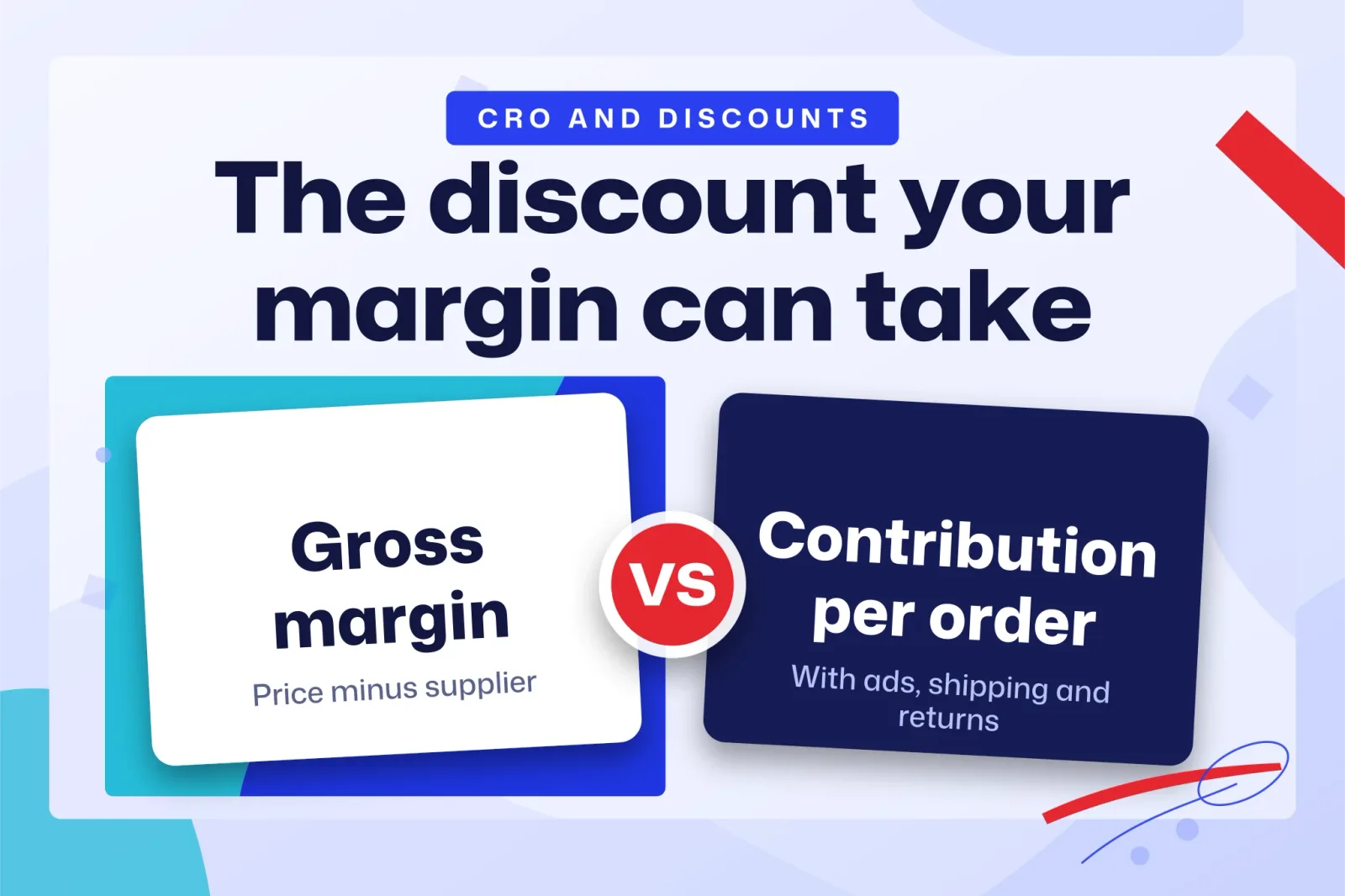
Contribution margin per order is what's left of the pre-tax price after paying everything it costs to fulfil that order. Calculate it on the price excluding sales tax or VAT; if you're unsure how tax applies to you, check with your accountant. All figures in this section are invented.
| Line | What it includes | Example |
|---|---|---|
| Average order value before tax | What the customer pays, minus sales tax or VAT | $60.00 |
| Cost of goods | What the merchandise in the order costs you | −$24.00 |
| Shipping | What shipping costs you and you don't charge the customer | −$6.00 |
| Payment fee | Your payment provider's fee, at your actual rate | −$1.80 |
| Returns and discounts | Average per order of what you lose to returns, coupons and markdowns | −$7.20 |
| Contribution margin | What's left to pay for acquisition, fixed costs and profit | $21.00 (35%) |
Use your own fees: take them from your invoices or your payment provider's dashboard rather than a generic figure. For returns, average the last few months and spread the cost across every order, including the ones nobody sent back.
Fixed costs stay out: rent, salaries, subscriptions. You pay them whether you win one customer or a hundred, so they're not part of each order's margin. They still have to be covered from somewhere, and that somewhere is the gap between what you pay per customer and your break-even CAC.
How often your customers come back, and how to stay conservative with little data
Expected orders per customer come from your own store's data. Take the customers who placed their first order in a given period, count how many orders they placed between them over the next 12 months, and divide orders by customers.
All figures in this section are invented. If 200 customers bought for the first time in January and together placed 300 orders by the following January, each customer places 1.5 orders a year.
Staying conservative comes down to the time window. Use only the period you've actually observed: if your store is a year old, don't project customers who keep buying for five. With only a few months of data, take the orders per customer you already have and don't add future purchases you can't be sure of. Your ceiling will come out lower, and finding out later that you could have paid more beats finding out the opposite. If you sell something people buy once every several years, like a mattress, count 1 order per customer and forget about repeat purchases.
From break-even CAC to target CAC and the CAC your cash flow can carry
Break-even CAC is the absolute maximum. The one to set as your target is break-even minus the profit you want from each customer, and the one your cash flow can carry depends on how much of the CAC the first order pays back.
All figures in this section are invented. With the same customer as before, break-even is $31.50. If you want to make $10 per customer, your target CAC is $31.50 − $10 = $21.50.
| Figure | Calculation | Result |
|---|---|---|
| Break-even CAC | $21 margin × 1.5 orders | $31.50 |
| Target CAC | $31.50 − $10 profit per customer | $21.50 |
| CAC paid back by the first order | First-order margin | $21.00 |
The third number is about cash. Ad money leaves today, while the margin from later orders arrives months afterwards, and only from some of your customers. Payback works like this: orders needed to recover CAC = CAC ÷ margin per order. With a $31.50 CAC you need 1.5 orders per customer; the first returns $21 and the remaining $10.50 depends on orders that come later. With a $21.50 CAC, the first order covers everything except $0.50.
If your cash position can't wait, the CAC you can afford is the one the first order pays back, even if break-even sits higher. If you can wait, your target can move closer to break-even, as long as the repeat rate you're using is one you've measured. To apply any of the three limits campaign by campaign, turn it into a ROAS with the break-even ROAS calculation.
10% or 3:1? Why the rules of thumb contradict each other
The two most repeated rules give very different limits because they're applied to different bases and neither explains where it comes from. Juan Merodio's article on Shopify's Spanish-language blog (2020) proposes that acquisition cost should be 10% of lifetime value, and Doofinder (Llorenç Palomas, 2022) repeats that CAC should ideally not exceed 10% of LTV. Neither cites a source for the percentage.
The other rule lets you spend a lot more. IEB School (2026) defines the acquisition cost limit as the maximum you're willing to invest to win a new customer and sets it at LTV divided by 3, also without a source. Shopify's English blog (2026) calls a 3:1 ratio the sweet spot and says ecommerce businesses typically see ratios between 3:1 and 4:1, with LTV calculated from revenue. On the same base, the 10% rule is a 10:1 ratio and lets you spend less than a third of what 3:1 allows.
These rules get copied without anyone rechecking the arithmetic. In the hypothetical example in the Spanish-language Shopify article, a CAC of €382 against an LTV of €24,000 is described as going over 10%. The numbers say otherwise: 382 ÷ 24,000 is 1.59%, and 10% of €24,000 would be €2,400. It's a slip in a 2020 piece, but it shows how easily a rule gets accepted without being checked.
Cyberclick (2021) admits there's no concrete answer because it depends on each company. It's right that no single percentage works for every store. Each store does have its own number, its break-even CAC, and it comes from its own data.
Example: the same customer under both rules and both bases
The customer is the one from the start: 1.5 orders of $60 before tax and $21 of contribution margin per order. Revenue LTV is $90 and margin LTV is $31.50, which matches break-even CAC. The rules are the 10% from Shopify's Spanish-language blog and the 3:1 ratio from Shopify's English blog.
| Rule | With revenue LTV ($90) | With margin LTV ($31.50) |
|---|---|---|
| CAC at 10% of LTV | $9.00 | $3.15 |
| CAC at LTV ÷ 3 (3:1 ratio) | $30.00 | $10.50 |
| Profit per customer at 10% | $22.50 | $28.35 |
| Profit per customer at 3:1 | $1.50 | $21.00 |
The 3:1 rule on revenue, the one Shopify presents as the sweet spot, lets you pay $30. That's $1.50 short of break-even, with almost no profit and no cushion if you misjudge repeat purchases: if customers place 1.4 orders instead of 1.5, accumulated margin drops to $29.40 and that CAC already loses money.
The 10% rule on revenue goes to the other extreme, with $9 per customer when you could pay more than three times that without losing money. Shopify's blog itself warns that too high an LTV:CAC ratio suggests you're not growing as fast as you could be. On a margin base, closer to what a16z argues for, the 3:1 rule gives a $10.50 CAC and $21 of profit per customer. That's a cautious position, and at least it's calculated on what the customer actually leaves you.
How to raise the CAC you can afford without paying more per ad
Break-even CAC goes up in three ways: more margin per order, more orders per customer, or customers who bring in other customers. All three raise the ceiling without touching what you pay Meta or Google.
For example, with the customer from the start, lifting margin per order from $21 to $24 moves break-even from $31.50 to $36, and going from 1.5 to 1.7 orders per customer takes it to $35.70. Margin improves when you raise average order value or cut returns and sitewide discounts; repeat purchases improve with a product people rebuy and a reason to come back. Watch the welcome coupon: it's an acquisition cost and belongs in the calculation, as in working out how much discount to offer without losing margin.
The third route changes the maths in a different way. If a customer you paid for brings in another, the ad spend is split across two. Whatever you pay for that referral, whether a commission or a discount, is the cost of acquiring the second customer, and it's compared against the same ceiling. The guide on how referral marketing works and how much you can pay per customer runs that calculation in detail.
Tuko, the app that publishes this blog and therefore an interested party, works that third route inside the store. It adds a group buying button to the Shopify product page. The customer pays with the discount already applied in the store's normal checkout and has 24 hours, or 48 if you choose, for someone else to join through their link, which they can share on WhatsApp. The group price only applies if that second person joins, so nobody gets it without bringing another customer. That's why the discount works as the cost of acquiring the second customer. A sitewide discount, by contrast, also goes to people who would have bought anyway. To understand the model, read what group buying is and how it differs from Groupon.
It has its limits. The group discount comes off the margin of both orders, so the calculation above works the same way, with a lower margin per order. And if the group doesn't fill, the order isn't shipped: the customer chooses between keeping the missing units at the group price, switching to another open group for the same product, or getting their money back.
Frequently asked questions
Does CAC include the welcome coupon?
Yes, as long as you count it only once. The coupon is part of the cost of winning the customer, in line with the full acquisition cost that a16z calls for. You can subtract it from first-order margin or add it to CAC, but not both, or you'd count it twice.
What's the difference between CAC, CPA and ROAS?
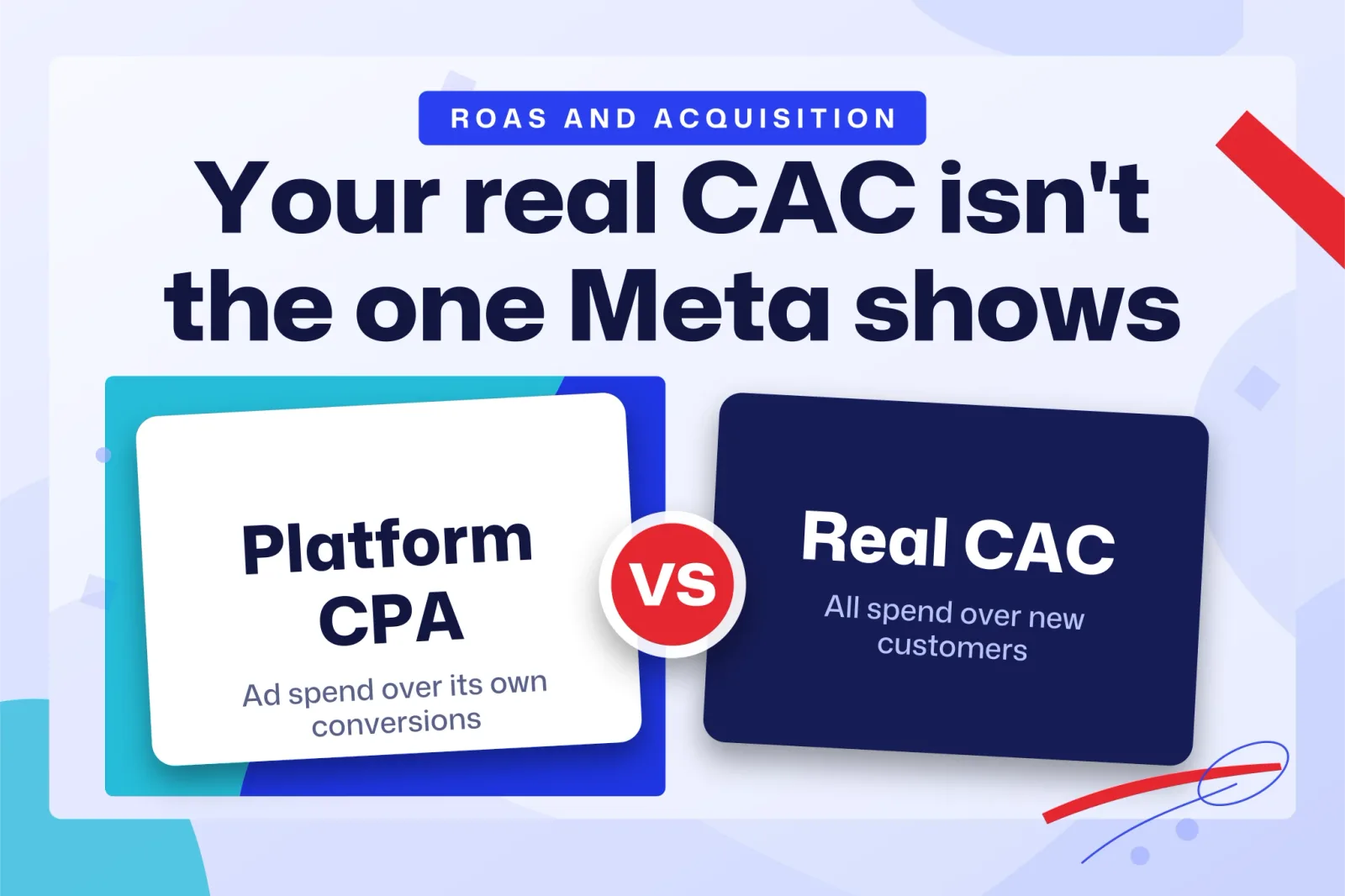
CAC measures what each new customer costs. CPA measures cost per conversion, and a conversion can be the second purchase of someone who was already a customer, so you'd expect CPA to come out lower than your CAC and it isn't the right figure to compare against your ceiling. ROAS divides attributed revenue by ad spend, and to find the one you need, see the break-even ROAS calculation.
Start by filling in the margin table with your real costs, count how many orders the customers who joined a year ago placed over 12 months, and multiply the two figures. Compare the result with your paid CAC for the last quarter: if your paid CAC is higher, review campaigns before scaling, and if it's well below, you have room to grow faster. If you want each customer to be able to bring in another, install Tuko from the Shopify App Store; installation takes about two minutes, you don't need to touch your theme and you don't need Shopify Plus.