Written with artificial intelligence by Tuko's editorial system, from the sources linked below. If you spot a mistake, write to joan@tukoteam.com.
Word of mouth marketing strategy for ecommerce, with the cost of each new customer worked out
A word of mouth marketing strategy for an ecommerce store means giving customers a reason to recommend you and knowing what you pay for every new customer who arrives that way. There are four ways to trigger it: an experience worth talking about, customer reviews, a referral program, and shared pricing or group buying. None of them is free. To choose between them, divide what each one costs you by the customers who would not have shown up without it.
Then compare that number with what a single order leaves you. If you don't have that figure yet, the method is in how much you can spend to acquire a customer without losing money. This guide applies the same logic to each form of word of mouth, using one example store throughout and showing every calculation.
What word of mouth marketing is, and what else it gets called
Word of mouth marketing is whatever a store does to get its customers recommending it to other people. Shopify's Spanish-language blog defines it as a tactic used to generate natural conversations and recommendations about a product or company. You'll see it shortened to WOM or WOMM, and sometimes called referral marketing or recommendation marketing, although referral marketing usually refers to one specific tactic covered below.
Word of mouth comes in two kinds. Organic word of mouth grows out of what the customer experiences: someone buys, likes it and tells a friend without being asked. The other kind is the one you set out to create. Zendesk calls it amplified word of mouth and, in its Spanish-language guide to word of mouth advertising, describes it as what happens when a company runs a campaign to get its brand into potential customers' conversations. This guide is about that second kind, because it's the only one you can plan and budget for.
Cost per new customer: the number to work out before choosing
The cost per new customer of any word of mouth tactic is what you spend on it divided by the customers who would not have arrived without it. The top half of that division is easy to know. The bottom half is where most calculations go wrong.
All figures in this section are invented. The store used across this guide has a $50 average order value and a 40% gross margin, so each order leaves $20 before acquisition costs. That $20 is your ceiling if you want to recover the cost on the first order; if customers come back, you can afford more. It's the same benchmark you'd use for a customer who arrives through ads, and turning it into a campaign target is covered in how to calculate break-even ROAS.
Cannibalization is what shrinks the bottom half. When the reward is a discount, people who would have bought anyway collect it too: the friend who already knew the store, the customer who was coming back regardless. That discount comes out of your margin and brings you nobody. The formula worth using looks like this:
cost per new customer = total cost ÷ (customers using that channel × share of them who wouldn't have come without it)
If 100 customers use a discount that costs you $10 each and 25 of them would have bought anyway, you spend $1,000 on 75 new customers. That's $13.33 each, not $10. The same effect during seasonal sales is explained in which Black Friday discounts bring in new customers and which ones just give away margin.
Option 1: give people something to talk about
Making your store worth talking about is the cheapest option per order and the hardest to measure. What people mention is usually a specific detail, such as a parcel that arrived earlier than promised or a handwritten note in the box. You pay for that detail on every order, whether the customer recommends you or not.
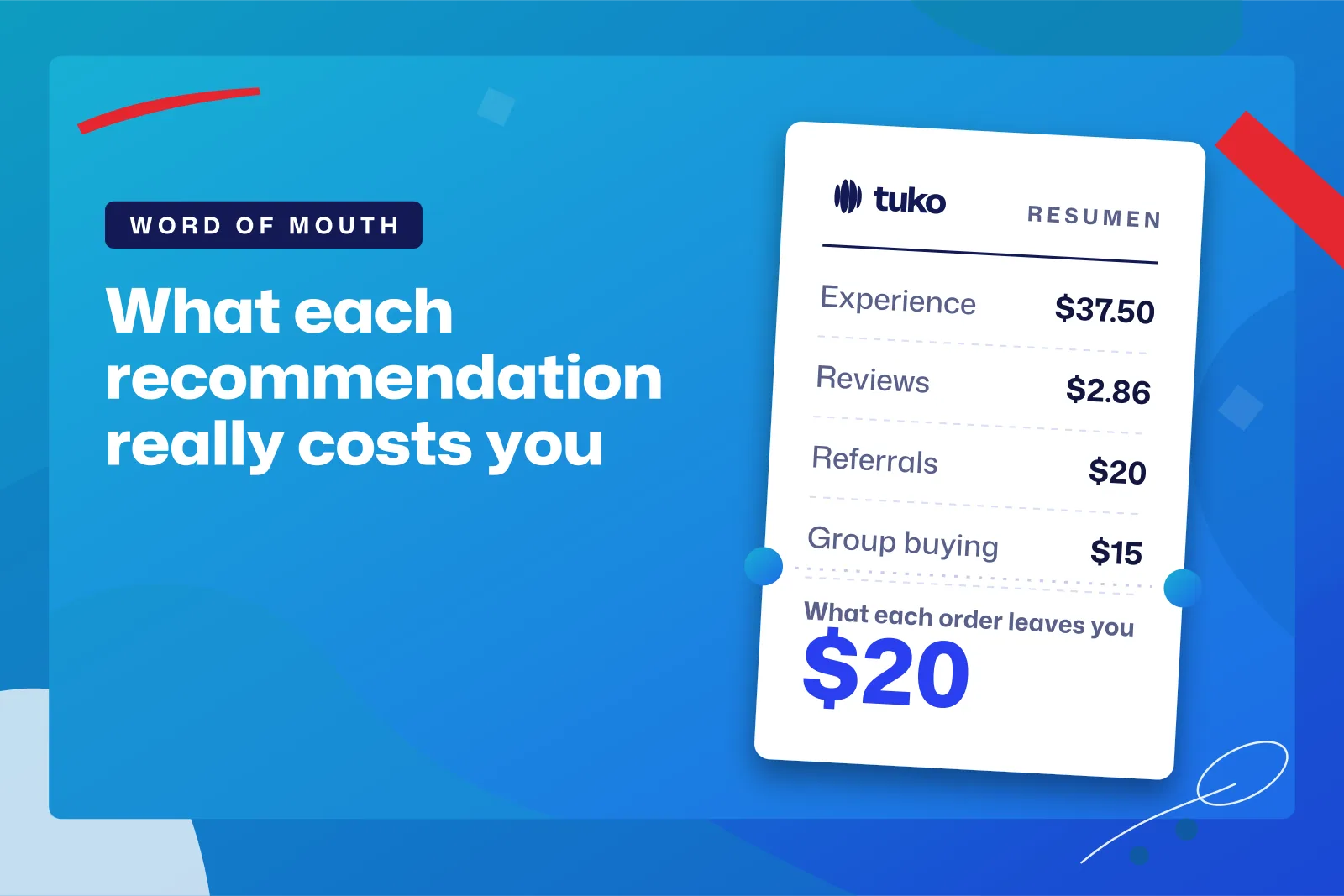
All figures in this section are invented. The example store puts a card and a sample in every parcel at a cost of $1.50. Over a period it ships 1,000 orders, so it spends $1,500. In that same period, 40 new customers answer «someone recommended you» when asked how they found the store. That works out to 1,500 ÷ 40 = $37.50 per new customer, almost twice the $20 an order leaves. It only pays off if those customers buy again.
The figure is shaky in both directions. Some of those 40 would have heard about you anyway because of the product itself, card or no card, which makes the real cost higher. On the other hand, the card also nudges existing customers to reorder, so charging the full $1,500 to word of mouth overstates it. A small store has no clean way to separate the two effects.
The practical approach is a post-purchase question, «how did you hear about us?», with fixed answers that include «someone recommended you». If that answer doesn't move for several months after you add the card, the money would work harder somewhere else. Treat this option as a foundation and don't expect an exact number from it.
Option 2: reviews and customer photos convert visitors but don't bring them
Reviews and customer photos persuade people who are already looking at your product page; something else brought them there, whether an ad, Google or a recommendation. That's why their cost per customer comes out so low, and why it shouldn't sit side by side with the other three options without a caveat. You already paid for the visit elsewhere.
All figures in this section are invented. The store pays $20 a month for a reviews app and gets 10,000 visits a month. If conversion goes from 1.5% to 1.6%, orders rise from 150 to 160, ten more. If 70% of those orders come from new customers, that's 7 customers, and the cost is 20 ÷ 7 = $2.86 per new customer.
If the lift is only half as big, the cost doubles. At 1.55% conversion, orders go from 150 to 155; 70% of five is 3.5 customers and the cost rises to 20 ÷ 3.5 = $5.71. If conversion doesn't improve at all, there are no customers to count and the $20 isn't spread across anyone. With 10,000 visits, a difference of five or ten orders a month is easy to mistake for normal month-to-month noise, so compare long periods before you trust the lift.
Reviews are the right fit when you already have traffic and the product page doesn't persuade. If what you lack is visitors, they won't fix it.
If you offer something in exchange for a review, such as a discount or a gift, the sensible thing is to disclose it next to the review and never make it conditional on the review being positive. Consumer rules on incentivized reviews differ by country, so check with a professional before you set up a program like that.
Option 3: a give-and-get referral program
A give-and-get referral program rewards both sides: the person who recommends gets store credit and the person who arrives through their link gets a discount on their first order. Unlike the parcel extras, you only pay when a referred customer actually buys.
All figures in this section are invented. With $10 for each side, every referred customer costs you $20. Their first order leaves 20 − 10 = $10 of margin, and the other $10 goes out later, when the referrer spends the credit on their next purchase. All in, the referred customer's first order leaves $0: the program breaks even exactly at this store's limit and only makes money if the new customer comes back.
Cannibalization still has to be counted. If 30% of referred customers would have arrived anyway, only 7 out of every 10 referrals are new. You pay $200 for 7 customers, so the real cost is 200 ÷ 7 = $28.57, above the $20 an order leaves. That share is likely to grow when customers send the link to people who already had the store in mind.
How far to raise or lower the reward depends on your margin and on how often customers reorder; the detail is in how referral marketing works and how much you can pay per referred customer. Keep referrals and affiliate marketing apart. In a referral program, a customer recommends you to people they know and gets a one-off reward. In affiliate marketing, a third party such as a website or a content creator earns a commission per sale as part of their work, which behaves more like a paid channel than a recommendation between friends.
Option 4: shared pricing or group buying
With group buying, the lower price only applies if someone else buys the same product. That changes the reason to share. The buyer wants another person to join because their own discount depends on it, so no separate reward is needed. And someone who was going to buy anyway can't get the lower price without bringing in another customer, which a sitewide discount never asks of them.
Tuko, the app that publishes this blog, works this way, so read this section knowing we're an interested party. It adds a group buy button to the product page. The customer pays with the discount already applied in the store's normal checkout and has 24 hours for someone else to join, or 48 if the store chooses that. They share their link, for example on WhatsApp, and when the second person joins both orders go ahead as usual, each shipped to its own address. The store decides whether, at first, only friends of the person who opened the group can join, with the group opening to every visitor in the last 6 or 12 hours, or whether any customer can join from the start.
If the group doesn't fill, the customer chooses between keeping the missing units at the group price, moving to another open group for the same product, or getting their money back; if they don't answer within 12 hours, they're refunded automatically. The order doesn't ship until the group is complete. For your numbers, if the customer keeps the units, you've given the discount without gaining a new customer, even though you sell more units; if they take the refund, there's no sale and no discount cost either.
Group buying and volume discounts do different jobs. A bundle gets one customer to buy more units; a group gets more customers to arrive, and you can run both. How it differs from coupon sites is covered in what group buying is and how it differs from Groupon.
What a group of two costs
All figures in this section are invented. With a 15% discount on both orders, each one carries $7.50 off and the group costs $15. Each order leaves 20 − 7.50 = $12.50 of margin. The first buyer didn't arrive because of the group, so the $15 is charged to the second one: $15 per new customer if every second buyer is new.
If only 60% of second buyers are new customers, because the rest already shopped with you, the cost rises to 15 ÷ 0.6 = $25 per new customer. That 60% is a different assumption from the 70% used for referrals, and the comparison on equal terms is in the next table.
Example: the four word of mouth options compared
The four options differ in when you pay and in whether they bring new people or persuade the ones already arriving. The table puts them side by side using the store from this guide.
| Option | What you pay | When you pay it | What it does | Cost per new customer in the example | Why the customer shares |
|---|---|---|---|---|---|
| Experience worth talking about | Card and sample, $1.50 per order | On every order, recommendation or not | Brings new people, slowly | $37.50, with unreliable attribution | They have a story to tell |
| Reviews and photos | App fee, $20 a month | Every month | Converts people already arriving | $2.86 or $5.71; none if conversion doesn't improve | No sharing needed, the review sits on the page |
| Give-and-get referrals | $10 to the referrer and $10 to the new customer | Only when a referred customer buys | Brings new people | $20, or $28.57 if 30% would have come anyway | A reward for themselves |
| Group buying | 15% off both orders | When the group fills, or if the customer keeps the missing units | Brings new people | $15 per group, or $25 if only 60% of second buyers are new | Without another person they don't get their price |
The referral and group buying costs in the table rest on different assumptions, 70% new customers for referrals and 60% for the group. With the same share for both, the comparison shifts. At 70% for both, referrals cost $28.57 and the group 15 ÷ 0.7 = $21.43. At 60% for both, referrals cost 20 ÷ 0.6 = $33.33 and the group $25.
The break-even point comes from equating what each option costs per customer brought in. With a $50 order and a $10 + $10 reward, group buying costs less as long as 2 × discount × $50 stays below $20, meaning a discount under 20%. At 20% both cost $20; at 25% the group costs $25 and referrals come out cheaper. With a $100 order and the same fixed reward, the break-even drops to 10%. Neither is cheaper across the board: it depends on your order value, your discount and your reward.
Which word of mouth option fits your store
If you have little traffic, start with referrals or group buying, because those are the two options that bring new people to the store. If you already have traffic and the product page converts poorly, reviews target exactly that problem. An experience worth talking about is worth having in every case, as the base the others build on.
Between referrals and group buying, order value is the main deciding factor. With low order values, a fixed reward eats a large part of the margin and a shared percentage works better; with high order values the opposite happens, as the break-even calculation in the table shows. Product type matters too. Store credit for a next purchase motivates little if customers buy once every few years, while shared pricing fits products that friends with similar tastes recommend to each other.
The four combine well. Reviews help a visitor who arrives through a referral or a group link convert, and the detail in the parcel gives either of them something to talk about. What makes no sense is stacking a referral reward and a group discount on the same order, because you'd be paying twice for the same customer.
How to measure word of mouth in Shopify
You measure word of mouth in Shopify with two pieces that complement each other: a separate code or link for each option and a post-purchase question. The codes count who used the incentive; the question gives you a sense of how many would have come anyway.
Create a different discount code for each channel, one for the referral program and another for the parcel card, and don't reuse them in ads. On the links your customers share, add UTM parameters with their own source so those visits show up separately in your reports. That tells you how many orders go through each option.
The post-purchase question, «how did you hear about us?», with fixed answers, fills in the rest. If someone used the referral code and says they already knew you from Instagram, they're probably a customer who would have arrived anyway. Counting those answers over a few months gives you a rough estimate of cannibalization, which is the input that moves cost per new customer the most. It won't be exact, because people misremember how they found a store, but it beats assuming everyone is new.
Mistakes that make each customer more expensive
Counting only the discount new customers take
The discount collected by people who would have bought anyway also comes out of your margin. If you only add up what new customers took, the cost per customer looks lower than it is. Divide the total cost by the customers who wouldn't have arrived without the discount.
Rewarding recommendations that were going to happen anyway
A referral program without rules can easily end up paying rewards to partners, flatmates and friends who already shopped with you. Limit the reward to people with no previous orders and watch for customers referring themselves with a second email address.
Fake reviews or undisclosed incentives
Buying reviews, writing them yourself or rewarding only positive ones strips them of their value, because shoppers only trust reviews they believe are real, and it exposes you to trouble under your country's consumer rules. If you give something in exchange for a review, say so on the review itself and get professional advice before launching the program.
Your next step is to redo these numbers with your own order value, your margin and an honest estimate of how many customers would have come anyway, then start with whichever option comes out cheapest for you. If that's shared pricing, you can install Tuko from the Shopify App Store; setup takes about two minutes, you don't need to touch your theme and you don't need Shopify Plus.