Written with artificial intelligence by Tuko's editorial system, from the sources linked below. If you spot a mistake, write to joan@tukoteam.com.
Is selling clothes online profitable? The math of one order with returns and ads
Selling clothes online is profitable when each order leaves money after you pay for the garment, shipping, returns and the ads that brought the customer in. Four numbers from your store decide it: gross margin, return rate, cost to acquire a customer and how often that customer buys again. With those four you can tell today whether your store gains or loses on each sale.
This article runs the full math on one clothing order with example figures, shows how returns change it and ends at the most you can spend on ads per customer. If you already know your margin and only need the ad ceiling, jump to how much you can spend to acquire a customer without losing money.
Is selling clothes online profitable? It depends on four numbers
Fashion profitability gets settled order by order. Gross margin is what remains between the price before tax and what the garment cost you. Return rate is the share of orders that come back. In clothing it tends to weigh more than in other categories, probably because size and fabric can't be checked until the parcel arrives. Acquisition cost is what you pay in ads for each new customer. Repurchase is what that customer buys later without you paying again to bring them in.
Most general guides list pros and cons of the business. They help little, because two stores selling the same T-shirt can make or lose money depending on who pays for the return or what a click costs. The useful thing is to do the math.
Example: the math of one clothing order, step by step
Every figure here is an example, kept round so you can swap in your own. A store sells a garment for $50 before tax. In the US, sales tax is added at checkout and collected for the tax authority, so it never counts as margin. In markets with VAT-inclusive prices, strip the tax out first and work from the net amount.
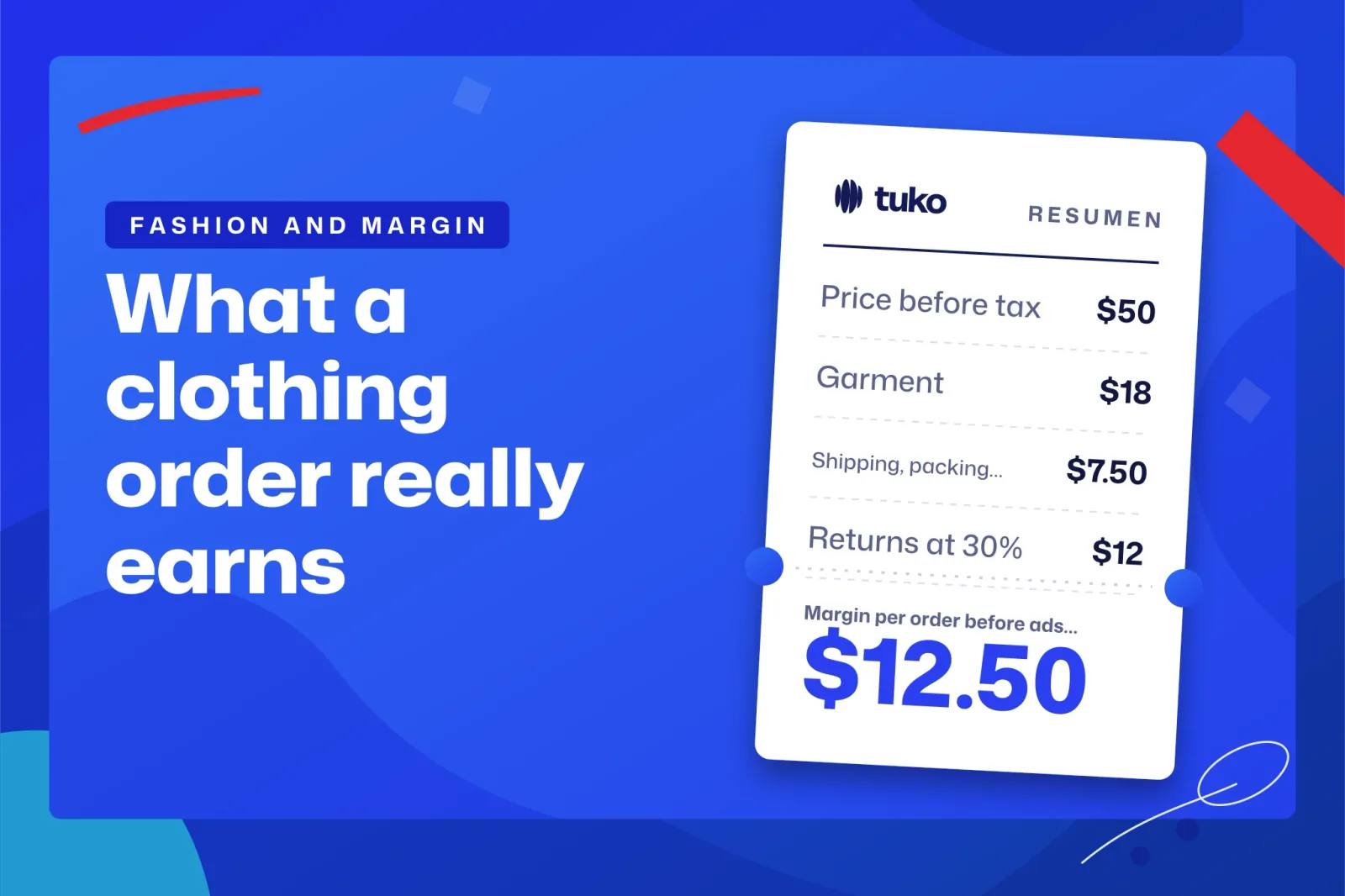
The garment costs the store $18, so gross margin is $32, or 64% of the price. Then come the costs of every shipment: $5 of postage (the store offers free shipping), $1 of packaging and a 3% payment fee, which is $1.50. Shipping, packaging and payment add up to $7.50.
| Item | Amount per order |
|---|---|
| Price before tax | $50.00 |
| Cost of the garment | -$18.00 |
| Shipping to the customer | -$5.00 |
| Packaging | -$1.00 |
| Payment fee (3%) | -$1.50 |
| Contribution margin, before returns and ads | $24.50 |
That $24.50 is the ceiling. No order has been returned yet and no ad has been paid for, and in a clothing store both happen.
How much do returns cost an online clothing store?
All figures in this section are invented. A return costs you twice: you lose the margin on that sale and you pay the costs of an order that earns nothing. In the example, a returned order costs the outbound shipping ($5), packaging ($1), return shipping if the store pays for it ($6), inspecting and restocking the garment ($2) and the payment fee, assuming it isn't refunded ($1.50). That is $15.50 per returned order, and the garment goes back on the shelf.
For an average order the margin works out as 24.50 × (1 − return rate) − 15.50 × return rate. Simplified, that is 24.50 − 40 × return rate. Every 10 points of returns take $4 off each order. At a 30% return rate, $12 comes off every order and the margin drops to $12.50.
| Return rate | Margin per order if the store pays return shipping | Margin per order if the customer pays return shipping |
|---|---|---|
| 0% | $24.50 | $24.50 |
| 10% | $20.50 | $21.10 |
| 20% | $16.50 | $17.70 |
| 30% | $12.50 | $14.30 |
| 40% | $8.50 | $10.90 |
With these figures the store stops making money per order when returns reach 61%, before paying for any advertising. That sounds far away, but the margin left at 40% can't absorb almost any acquisition cost.
Making the customer pay return shipping improves the direct math only a little: $1.80 per order at a 30% return rate. The bigger effect is probably on how many customers decide to return at all, and only your own store can measure that. What you may charge customers and within what deadlines depends on consumer rules in your country, so check with a professional before changing your policy.
Size exchanges have a different math. You pay two extra shipments, but the sale stays. If your store offers exchanges instead of refunds, count exchanges and money-back returns separately.
How much can you spend on ads per clothing customer?
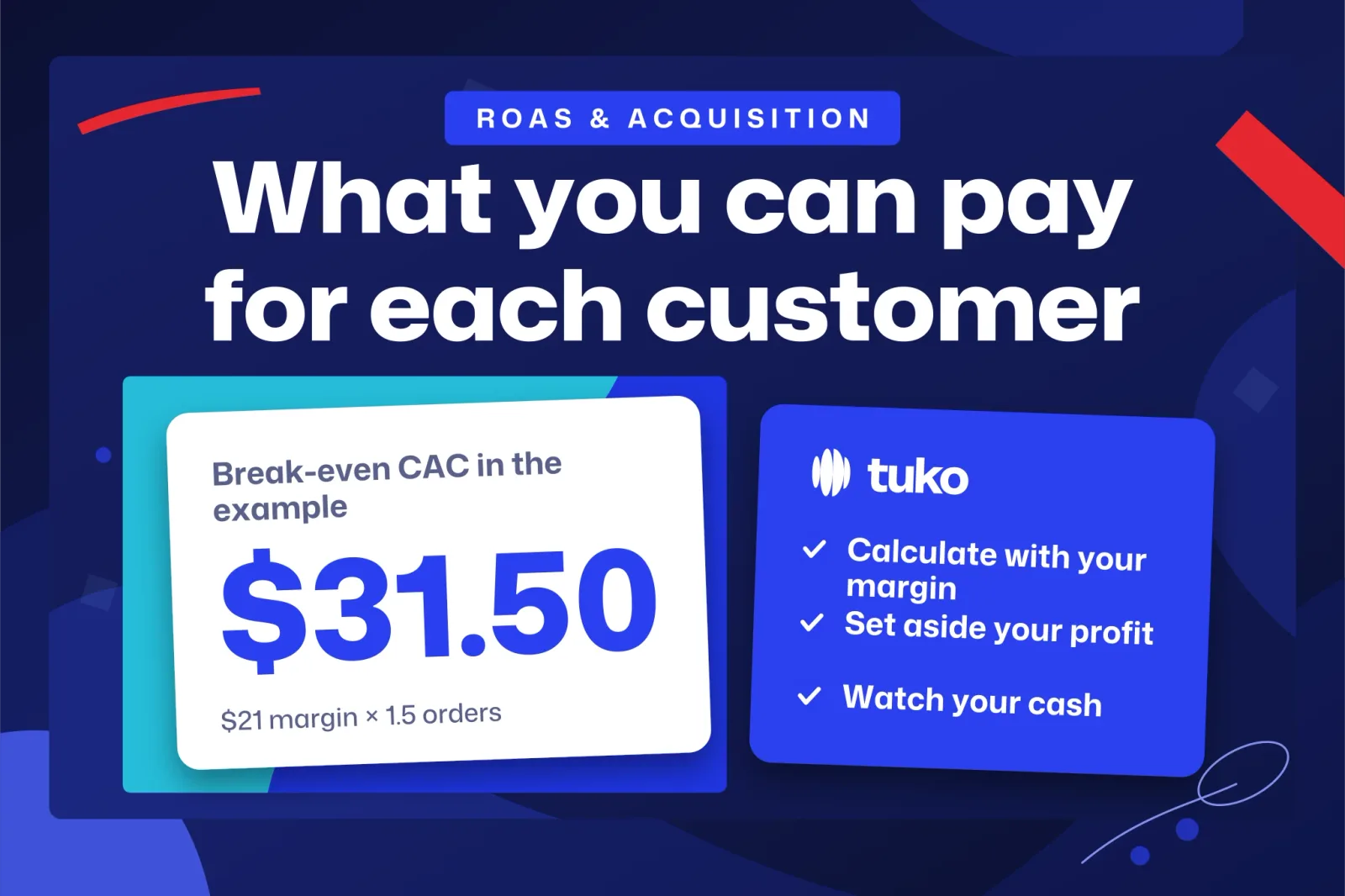
All figures in this section are invented. If the customer buys only once, the most you can spend to acquire them is the margin their order leaves after returns. In the example, with 30% returns, that is $12.50. Pay more and every sale costs you money.
Break-even ROAS comes from the same math: revenue per order divided by margin per order. With $50 of revenue before tax and $12.50 of margin, break-even ROAS is 4. Below $4 of sales per $1 of ads, the store loses. The step-by-step formula is in how to calculate break-even ROAS.
| Return rate | Margin per order (maximum cost per customer) | Break-even ROAS on $50 before tax |
|---|---|---|
| 0% | $24.50 | 2.04 |
| 10% | $20.50 | 2.44 |
| 20% | $16.50 | 3.03 |
| 30% | $12.50 | 4.00 |
| 40% | $8.50 | 5.88 |
Two adjustments change the number. The first is tax. If your prices include VAT and your ad platform reports order value with tax, a $50 sale shows up as $60.50 at a 21% rate, and the break-even ROAS you compare against rises to 4.84 (60.50 divided by 12.50). Check which amount the platform receives before comparing. The second is returns. Check how your ad platform treats refunds: if it books the revenue on the purchase day and keeps it in the report when the garment comes back a week later, the ROAS you see is too high. That is why a clothing store's break-even ROAS should use the margin after returns.
Repurchase raises the ceiling. If 4 in 10 customers place a second order within the year by email or direct visit, with no ad spend, and each of those orders leaves $12.50, the average customer is worth $5 more (0.4 × 12.50). The maximum cost per customer rises to $17.50 in the first year. Be careful with repurchases you haven't seen yet: counting them is the fastest way to justify advertising that loses money. To keep the two metrics apart, read ROAS vs customer acquisition cost and how to calculate customer acquisition cost.
Which levers improve clothing store profitability without giving away margin?
All figures in this section are invented. Cutting returns is the lever that moves a clothing store's math the most. The starting case is the one above: 30% returns, $12.50 of margin per order and $7.50 of ads per customer, which leaves $5 of profit per order. Each row changes one thing only.
| Lever | Assumption | Margin after returns | Profit after ads | Change |
|---|---|---|---|---|
| Starting point | $50 before tax, 30% returns, $7.50 of ads | $12.50 | $5.00 | Baseline |
| Fewer returns | From 30% to 20% | $16.50 | $9.00 | +$4.00 |
| Higher average order value | $55 before tax, product cost scales with price | $14.59 | $7.09 | +$2.09 |
| Better conversion | 20% more orders on the same spend: $6.25 per customer | $12.50 | $6.25 | +$1.25 |
| 20% discount for everyone | $40 before tax | $5.80 | -$1.70 | -$6.70 |
Ten points fewer returns are worth almost double a 10% rise in order value. In clothing, returns often come from sizing, so the work happens on the product page: real garment measurements in centimeters or inches, the size the model wears and their height, how the fabric stretches and whether reviews say the piece runs large or small. It is cheap work and leaves the price alone.
Average order value helps, with a limit. The $55 row assumes the return rate stays the same, and an order with two garments has more chances of a partial return. The options that don't destroy margin are in how to increase average order value with bundles, free shipping and cross-sell. Conversion lowers the cost per customer without touching margin; the math for it is in how to optimize your store's conversion rate and margin.
The across-the-board discount is the only row in the red. A 20% cut given to everyone is also collected by shoppers who would have paid full price, and with returns and ads each order ends up losing $1.70. If you need a lower price to attract customers, it is better that only someone who brings something in return gets it.
That is the logic of group buying. With Tuko, the customer pays the discounted price in the store's normal checkout and has 24 hours, or 48 if the store chooses, for another person to join through their link. The lower price only applies if one more customer arrives. With a 10% discount, each order in this math leaves $9.15 after returns. If the first customer cost $7.50 in ads and the second came in through the shared link, the group leaves $10.80, against $5 for the single order. The math only holds if the group completes and the second customer wasn't going to buy anyway. If the group doesn't complete, the order isn't shipped and the customer chooses between keeping the units at the group price, moving to another group or getting their money back, so you don't pay for a shipment that never goes out. For the wider channel of customers bringing customers, see word of mouth marketing strategy for ecommerce.
When does the math of selling clothes online not work?
All figures in this section are invented. The math fails when gross margin is low, when the garment is cheap and the store pays shipping and returns, or when cost per customer exceeds margin and no repurchase makes up for it.
| Scenario | Margin after returns (30%) | Ads per customer | Result per order |
|---|---|---|---|
| Own brand from the example | $12.50 | $7.50 | $5.00 |
| Resale, garment at 60% of the price | $4.10 | $7.50 | -$3.40 |
| $20 garment before tax, free shipping and returns | -$0.04 | No ads | -$0.04 |
| Own brand with expensive ads | $12.50 | $15.00 | -$2.50 |
Reselling other brands has the same cost structure as an own brand, but with $20 of gross margin instead of $32. After returns $4.10 remain, and any ad turns it into a loss. Reselling can work if the brand already brings its own searches and the customer arrives without you paying for them; with paid traffic, the math is very tight.
The cheap garment loses money before it is advertised. At $20 before tax, a garment costing $7.20 leaves $6.20 after shipping, packaging and payment fee, and each return costs $14.60. Logistics costs are nearly fixed and the price can't carry them. To sell cheap garments you need a minimum order for free shipping or a basket of several pieces.
This math leaves out two costs that matter in fashion: unsold stock and end-of-season markdowns. If you buy by season, the logical move is to set aside part of the margin for clothes that will end up discounted or unsold, and check that the store still makes money with that discount applied to the last part of the stock.
How to run the math with your own store's data
You need data from the last three to six months so one good or bad week doesn't distort the result. This order works:
- Average price before tax. Divide net sales before tax by the number of orders. Shopify's sales report documentation describes what each column contains.
- Cost of the garment. Take it from supplier or workshop invoices, with transport to your warehouse included.
- Shipping, packaging and payment fee. From carrier invoices, your box supplier and your payment gateway statement.
- Return rate. Orders with a refund divided by total orders in the period. Shopify's help page on creating returns covers how to record a return from an order. Keep size exchanges separate.
- Cost per return. Outbound shipping, return shipping if you pay it, review time and the share of garments that can't be resold.
- Cost per new customer. Ad spend in the period divided by new customers in the same period.
- Repurchase. What share of customers from a year ago has bought again. If your store is new, run the math without repurchase.
With those seven data points, fill in the margin-after-returns formula and subtract the cost per customer. If the result is positive, each order contributes money toward your fixed costs. If it is negative, the levers table tells you where to start.
Frequently asked questions
What gross margin does an online clothing store need to be profitable?
There is no universal percentage, because it depends on your shipping, your returns and your cost per customer. For example, with $50 before tax, 30% returns and $7.50 of ads per customer, a 64% gross margin leaves $5 per order and a 40% one loses $3.40. Work out yours backwards from the cost per customer you pay today.
How many orders a month do you need to cover fixed costs?
Divide the month's fixed costs (platform, apps, warehouse, your own pay) by the profit per order after returns and ads. For example, with $1,500 of fixed costs and $5 of profit per order, you need 300 orders a month. If profit per order is negative, selling more makes the loss bigger.
What to do now
This week, pull your real return rate and your cost per new customer and put them in the example table in place of the invented ones. If the margin after returns doesn't cover your ads, start with the product page and sizing before raising budget. And if you want to attract customers with a lower price without handing it to people who would have bought anyway, you can install Tuko from the Shopify App Store in about two minutes, without touching your theme, and try it on a couple of products.