Written with artificial intelligence by Tuko's editorial system, from the sources linked below. If you spot a mistake, write to joan@tukoteam.com.
How much discount to offer on Black Friday without losing margin, with ad costs and cannibalization counted
The most you can discount on Black Friday without losing margin is 1 − (minimum acceptable price ÷ list price), and that minimum price has to include what each event order costs you in ads. Subtract what you lose on customers who would have bought at full price anyway, and the percentage your store can afford often lands well below the generic ranges you see quoted. Black Friday falls on Friday, November 27 this year and Cyber Monday on November 30, which leaves time to run the numbers product by product.
If you have already worked out how much you can pay for each sale in advertising, half the math is done: it follows the same logic as how to calculate break-even ROAS and how much each discount raises it.
How much discount you can offer on Black Friday
You can discount until the sale price hits your minimum acceptable price. Base.com's Black Friday guide (October 2026, in Spanish) puts it in one formula, maximum discount = 1 − (minimum acceptable price ÷ list price), and warns that past that limit a store sells at a loss even while revenue goes up.
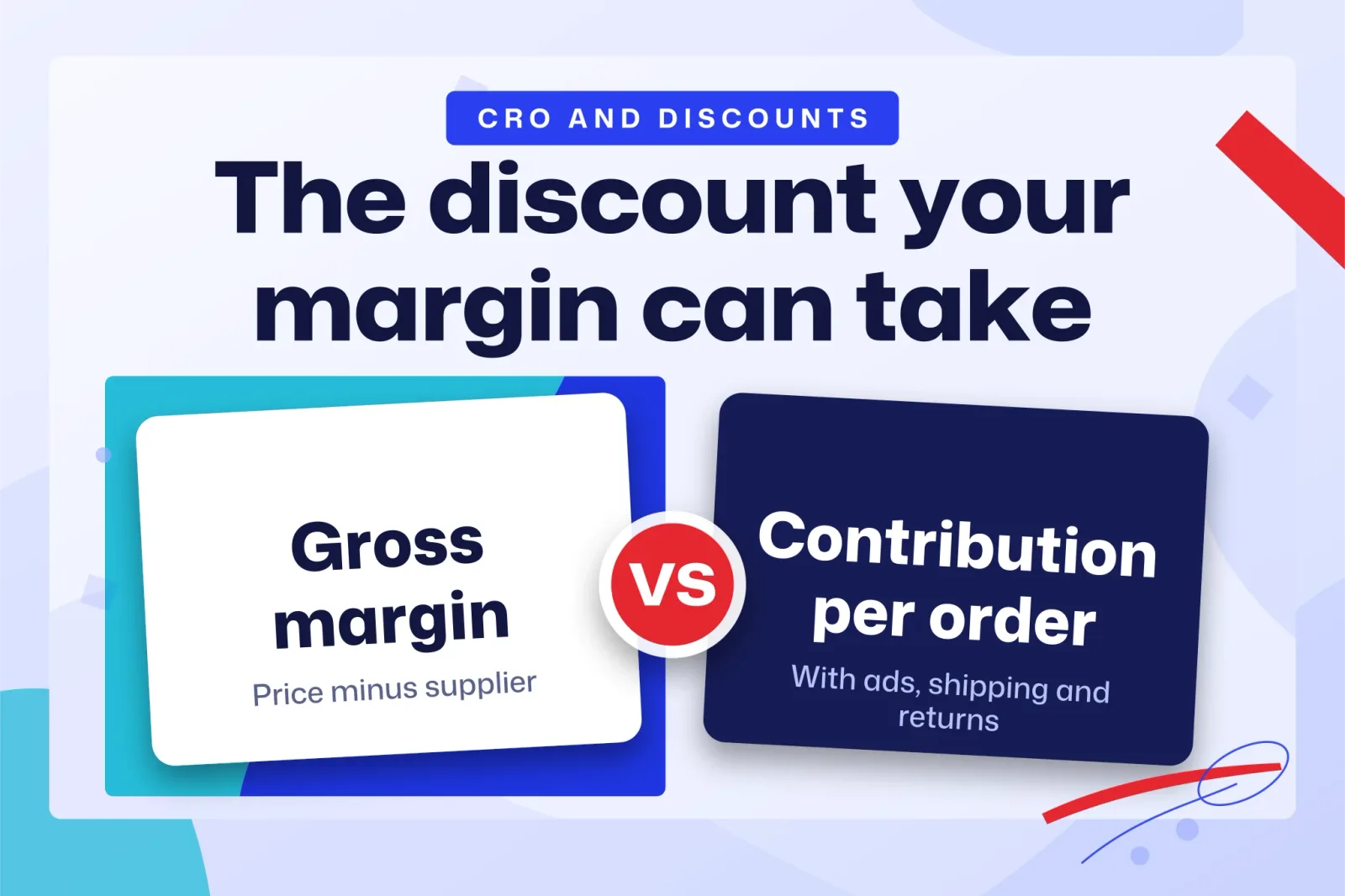
Most stores measure that limit against gross margin, meaning price minus what the supplier charges. The number that decides it is contribution per order: what is left after every cost that comes with a sale, such as shipping, packaging, returns, payment fees and the ad that brought the customer in. A $60 product that costs you $25, for example, looks like $35 of margin, but if shipping, packaging, returns and fees leave you only $22, a 25% discount takes $15 of price out of those $22, not out of $35.
Work out your minimum price per order, ads included
The minimum price per order is your fixed costs per unit plus the margin you won't go below plus ad cost per order, divided by what remains of the price after percentage-based costs. Base.com writes it as minimum price = (fixed costs per unit + minimum margin) ÷ (1 − sum of percentage costs). That guide subtracts advertising at the end as a lump sum. Here it goes inside the numerator as one more cost of each order, because during Black Friday every sale that comes from an ad pays for that ad.
All figures in this section are invented.
A product listed at $60 has these fixed costs per unit: $25 for the product, $6 shipping, $1 packaging and $3 set aside for returns, $35 in total. Fees charged as a percentage of the price add up to 5%, so the divisor is 0.95. At full price the fees come to $3 and contribution is 60 − 35 − 3 = $22.
| Scenario | Fixed costs + margin + ads | Minimum price | Maximum discount off $60 |
|---|---|---|---|
| No minimum margin, no ads | $35 | $36.84 | 38.6% |
| $3 minimum margin | $38 | $40.00 | 33.3% |
| $3 margin and $5 of ads per order | $43 | $45.26 | 24.6% |
| $3 margin and $8 of ads per order | $46 | $48.42 | 19.3% |
The first row is what you get if you only look at product and logistics costs: close to 39%. A modest minimum margin brings it down to a third. Once the event's acquisition cost goes in, the cap drops below 25%. If bids climb in November and each order costs $8 in ads instead of $5, the cap stops at 19.3%.
The ad cost per order (CPA) you plug in should be the one you expect during the event, not a quiet month's. The sensible source is what you paid per order last Black Friday; without that history, push your usual CPA up.
How many more orders you need to earn the same with a discount
To earn the same with a discount, multiply your orders by full-price contribution divided by discounted contribution. If a regular order leaves you three times what a discounted one does, you need three times as many discounted orders to stay level.
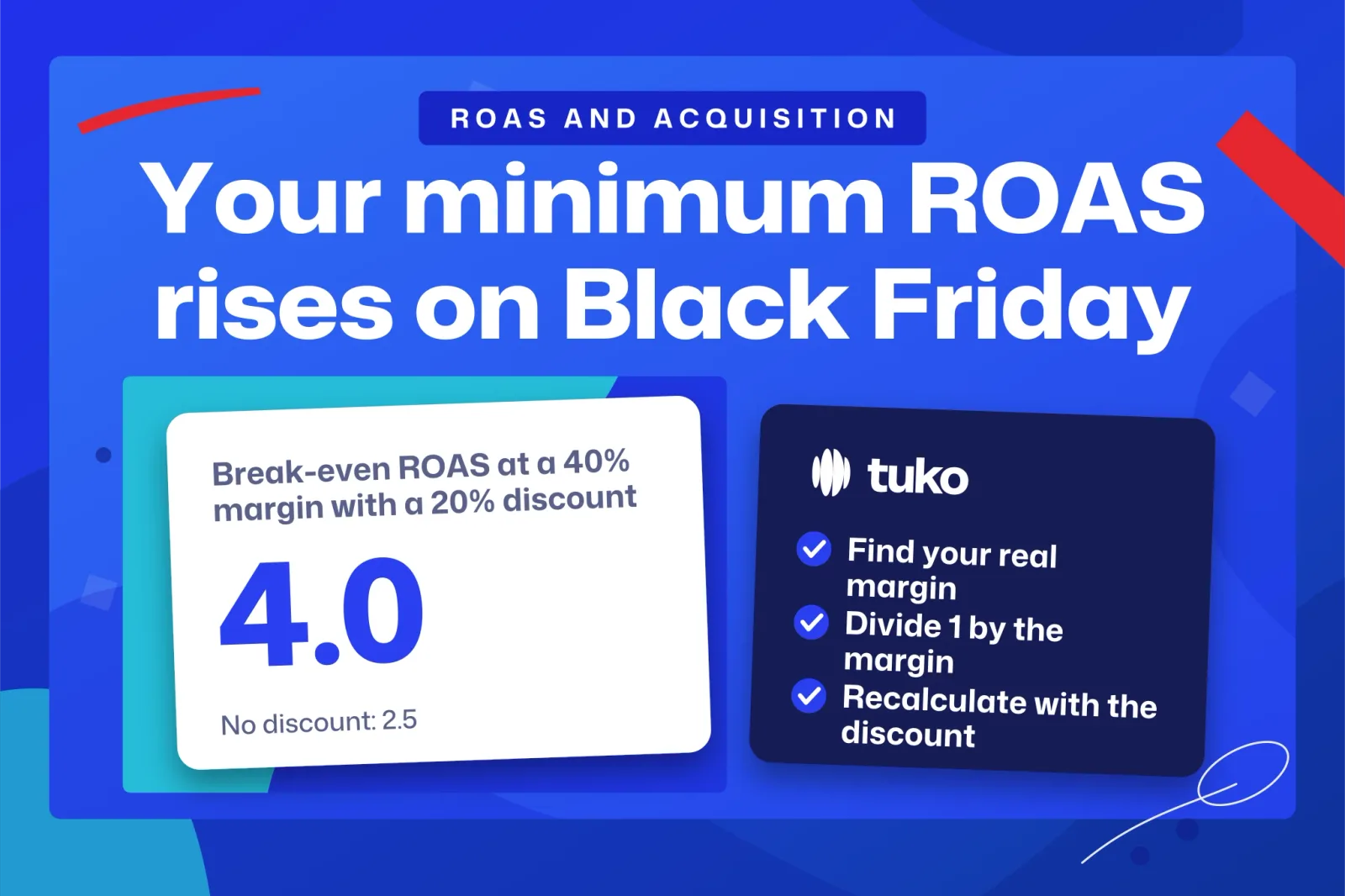
In base.com's example, a 20% discount means selling 2.5 times as many units to earn the same. That figure is the per-unit contribution without the discount in their example divided by the contribution with it, 15,500 ÷ 6,200 = 2.5. Their example uses Argentine pesos and local taxes, so redo it with your own costs.
All figures in this section are invented.
With the product from the previous section ($60 price, $35 fixed costs, 5% fees and $22 contribution at full price), each discount leaves this. Full-price orders are assumed to carry no ad cost; if yours do, subtract it from the $22 baseline too.
| Discount | Price | Contribution per order | Orders needed (no ads) | Contribution with $5 of ads | Orders needed (with ads) |
|---|---|---|---|---|---|
| 10% | $54 | $16.30 | 1.35x | $11.30 | 1.95x |
| 20% | $48 | $10.60 | 2.08x | $5.60 | 3.93x |
| 25% | $45 | $7.75 | 2.84x | $2.75 | 8x |
| 30% | $42 | $4.90 | 4.49x | −$0.10 | You lose on every order |
Discounted contribution is 0.95 × price − 35. At 25% with no ads it looks manageable: 2.84 times the orders. With $5 of ads per order you need eight times the orders, and at 30% every sale loses money. Few stores multiply their orders by eight overnight, which is why acquisition cost moves the decision more than the percentage itself.
Customers who would have bought anyway cost you too
Every discounted order that would have happened at full price costs you the gap between the two contributions. That is cannibalization, and almost no Black Friday guide puts it in the math because it shows up in no report: the order is logged as one more sale.
The promotion pays off when this holds: new orders × discounted contribution ≥ cannibalized orders × (full-price contribution − discounted contribution) + event ad budget.
All figures in this section are invented.
Same product, 20% off: contribution drops from $22 to $10.60, so each cannibalized order costs $11.40. Say Black Friday brings 300 orders, 100 of which would have come in at full price anyway, and you spend $1,500 on ads ($5 per order). The 200 new orders contribute 200 × 10.60 = $2,120. The promotion's costs are 100 × 11.40 = $1,140 plus $1,500 in ads, $2,640 in total. You end up $520 worse off than doing nothing: without the promotion you would have made 100 × 22 = $2,200, and with it you make 300 × 10.60 − 1,500 = $1,680. With that ad budget, you would need 250 new orders to break even (2,640 ÷ 10.60 = 249.1).
No reliable cannibalization rate applies to every store, so estimate yours from your own data:
- Same period last year. Look at your orders in the weeks before and after last Black Friday. If sales dipped below normal after the event, part of the discounted orders were purchases pulled forward.
- Share of repeat customers. Count how many discounted orders came from people who had bought before. Not all of them would have bought anyway, but they are the group most likely to.
- Control group. If you send the offer by email, hold back part of the list and compare how much each group buys. The gap is what the discount really adds.
Research on this for online stores is thin, but the idea has support. A 2010 survey by Utpal Dholakia (Rice University), reported by Phys.org, asked 150 businesses in 19 US cities about their Groupon promotions: they were profitable for 66% and unprofitable for 32%, and more than 40% would not run one again. The study concludes that these promotions benefit most the businesses where they don't cannibalize sales to existing customers. Those were daily deals, not Black Friday, and the data is self-reported, so treat it as a pointer rather than a benchmark for your store. The difference between those coupons and group buying inside your own store is explained in what group buying is and how it differs from Groupon.
What to do if your maximum discount comes out too low
If the math won't support the percentage you wanted to advertise, change the shape of the discount before its size. A flat sitewide discount cannibalizes the most, because a first-time visitor and someone who already had the product in their cart get exactly the same price.
- Different discounts per product. Use a couple of high-contribution products as the hook and give the rest a smaller discount or none. Products that can't hold the minimum price stay out of the promotion.
- Bundles. A bundle raises order value and spreads shipping and packaging across several units, so contribution per order drops less than with a per-unit discount.
- A gift instead of a markdown. A gift that costs you little can be worth more to the customer than it costs you, and it leaves your previous price untouched.
- Free shipping threshold. Set it above your average order value so the incentive nudges people to add one more item.
- Limited units or channel. A discount only for your email list, or for a fixed number of units, caps what you can lose.
- A discount that requires bringing another customer. That is what Tuko does. We build it, so we have a stake here.
Tuko adds a group buy button to the product page. The store picks the products and the discount; the customer pays with the discount already applied in the store's normal checkout and has 24 hours (or 48, if the store chooses) for someone else to join through their link. A sitewide discount also goes to people who were going to buy anyway. With Tuko the lower price only applies if one more person joins, so nobody gets it without bringing another customer, which goes straight at the cannibalization problem from the previous section. It works alongside bundles, because a bundle gets one customer to buy more units and Tuko brings in more customers.
It also has limits worth knowing before November 27. The order doesn't ship until the group is complete, which matters if your customers are buying gifts in a hurry. If the group doesn't fill, the customer chooses between taking the remaining units at the group price, moving to another open group or getting their money back. And headless stores aren't supported yet.
Strikethrough prices in Shopify and the previous price rule in Spain
In Shopify, you get a strikethrough price by entering the original price in the Compare-at price field and the sale price in the Price field. According to Shopify's Help Center page on sale prices, the compare-at price must be higher than the price, and using sale prices is different from setting up discounts. The compare-at price changes what shows on the product page; a discount is applied in the cart or at checkout. Our reading is that, for the margin math above, what goes into the formula is the price you end up charging, whichever option you use.
If you sell in Spain, any advertised markdown must show the previous price next to the reduced one, and that previous price is the lowest you charged for the same product in the previous 30 days, according to Article 20 of Spain's Retail Trade Law 7/1996 (consolidated text, in Spanish). The same article says a promotion can't be made conditional on a minimum or maximum discount percentage. In practice, the compare-at price you show Spanish customers should be that lowest 30-day price, so a price you raised in October doesn't work as the reference. This explains the rule and isn't legal advice: if you have doubts about your case, check with a professional. Rules in other countries differ, and we haven't verified them here.
10-minute checklist before November 27
- Work out the minimum price of every product you plan to mark down, with shipping, packaging, returns, fees and minimum margin.
- Put a number on the ad cost per order you expect during the event and add it to the minimum price.
- Get the maximum discount with 1 − (minimum price ÷ list price) and round down.
- Calculate how many times you need to multiply your orders to earn the same, and ask yourself whether that is realistic.
- Estimate what share of orders would arrive at full price anyway and check the profitability condition.
- Pull the products that can't hold the discount out of the promotion.
- If you sell in Spain, check each product's lowest price over the last 30 days.
- Confirm in Shopify that every compare-at price is higher than the price and matches that previous price.
Run the numbers today on your three best sellers: that tells you whether the percentage you had in mind holds up or whether you should change the shape of the promotion. If your biggest worry is giving margin away to people who would have bought anyway, you can install Tuko from the Shopify App Store in about two minutes, without touching your theme, changing your payment settings or needing Shopify Plus, and try it on your hook products.