Written with artificial intelligence by Tuko's editorial system, from the sources linked below. If you spot a mistake, write to joan@tukoteam.com.
How to increase average order value in ecommerce with bundles, free shipping and cross-sell, without losing margin
To increase average order value (AOV) in a Shopify store you have three levers you can measure: bundles or multipacks with a discount, free shipping above a set amount, and cross-sell of a complementary product. AOV is what the store takes per order: gross sales minus discounts, divided by the number of orders. Raising it only helps if what you keep per order after paying for product, shipping and discounts rises too, and with two of these three levers AOV can climb while total margin falls.
Below you have the math for all three on the same example store, the break-even formula for each and how each one is set up in Shopify. If you already work out your break-even ROAS, the number that matters here is the same one you use there: contribution per order.
How does Shopify calculate average order value?
Shopify calculates AOV by subtracting discounts from gross sales and dividing the result by the number of orders. According to Shopify's help page on the sales report, consulted in November 2026, the formula is (gross sales − discounts) / orders, excluding post-order adjustments such as edits or exchanges. Its own example: ($1,000 − $200) / 10 = $80. Shipping and taxes are left out.
That definition has two traps when you are choosing a lever. A discounted bundle raises AOV through the extra units and lowers it through the markdown, and the report only shows the net. Free shipping does not appear at all: what it costs you comes out of your margin, but the AOV you see in Shopify does not change because of it. That is why the sections below look at contribution per order, what you keep after paying for everything.
Example: the starting store
The three levers are worked out on the same hypothetical store so the results can be compared. It sells one product at $30 with a contribution margin of 40%: after paying for the product, payment fees and packaging it keeps $12 per unit. Each shipment costs $5 and the customer pays for it, so in the starting situation shipping neither adds nor subtracts.
| Item | Value |
|---|---|
| Product price | $30 |
| Contribution margin | 40% |
| Contribution per unit | $12 |
| Cost of one shipment (paid by the customer) | $5 |
| Orders | 1,000 |
| 1-unit orders | 700 |
| 2-unit orders | 300 |
| Units sold | 1,300 |
| Sales | $39,000 |
| AOV | $39.00 |
| Total contribution | $15,600 |
| Contribution per order | $15.60 |
How much discount can I give on a bundle without losing margin?
On a bundle of k units, the discount δ has to stay below m·(k−1)/k, where m is your contribution margin as a decimal. Above that cap, a customer who was going to buy one unit and takes the bundle instead leaves you with less money than if they had stayed with a single unit.
The formula comes from comparing the two purchases. With one unit you earn p·m, where p is the price. With the bundle you take in k·p·(1−δ) and pay k·p·(1−m) for product, so you keep k·p·(m−δ). The bundle pays off if k·(m−δ) > m, and solving gives δ < m·(k−1)/k.
All figures in this section are invented. In the example store, with a 2-unit bundle and a 40% margin, the cap is 0.4 × 1/2 = 20%. The table shows what the bundle leaves at three different discounts, against the purchases it replaces:
| Discount | Bundle price | Bundle contribution | Versus a 1-unit buyer ($12) | Versus someone who already bought 2 ($24) |
|---|---|---|---|---|
| 10% | $54 | $18 | +$6 | −$6 |
| 15% | $51 | $15 | +$3 | −$9 |
| 20% | $48 | $12 | $0 | −$12 |
People who already bought two also get the bundle price
All figures in this section are invented. The cap formula only looks at the customer who moves from one unit to the bundle. The 300 orders that already carried two units now pay the bundle price, and on those you give away the whole discount. If at 10% off, 150 of the 700 one-unit orders switch to the bundle, the store ends up like this:
| Item | Before | 2-bundle at −10% |
|---|---|---|
| 1-unit orders ($30) | 700 | 550 |
| 2-unit orders or bundle | 300 | 450 |
| Sales | $39,000 | $40,800 |
| AOV | $39.00 | $40.80 |
| Total contribution | $15,600 | $14,700 |
| Contribution per order | $15.60 | $14.70 |
AOV goes up $1.80 and the store earns $900 less. The 150 who switch add 150 × 6 = $900; the 300 who already bought two subtract 300 × 6 = $1,800. At 10% off, 300 of the 700 one-unit orders have to switch just to leave you where you started. At 15% off you would need 300 × 9 / 3 = 900, more than the 700 that exist, so that bundle loses money even if every one of them buys it.
Before launching a bundle, check how many of your orders already carry that quantity. If it is many, the sensible options are a bundle with more units than most customers already buy, or a smaller discount. With a 3-unit bundle, the cap from the formula rises to 26.7%.
How to set up a bundle in Shopify and what its limits are
Shopify's help page on bundles defines them as a set of two or more related products, commonly offered at a discount. To create them, Shopify Bundles is Shopify's own free app: it creates fixed bundles and multipacks from the admin and is available on all plans. For bundles where the customer picks the products (mix-and-match), Shopify points to third-party apps.
Some limits bear directly on the discount math:
- The bundle price does not update by itself. According to the Shopify Bundles documentation, if the price of one of the bundled products changes, manually or through a price import, the bundle price stays as it was. If you raise the price of the single product, your real discount on the bundle grows without you deciding it, so review the bundle every time you touch prices.
- It does not support purchase options. The bundles eligibility page says they are not compatible with subscriptions, pre-orders or try-before-you-buy. If you sell by subscription, the bundle has to go another way.
- It has no shipping profile of its own. The same page says so. Our reading is that the bundle's shipping is set by the products that make it up, which is worth checking if you combine it with a free shipping threshold.
What order amount should I set for free shipping?
Set free shipping at an amount that few orders reach today, because you also give shipping away to everyone who already exceeded it. It only pays off if the orders that grow to reach the threshold leave you more contribution than the shipping you give away costs. Shopify's shipping strategy guide acknowledges both sides: free shipping based on cart value can increase your total order value, while the shipping fees need to be accounted for elsewhere and can affect your profit margins. It gives no figure for the effect.
All figures in this section are invented. The example store sets free shipping from $60, which in its case equals two units. The 300 orders that already carried two units stop paying for shipping and the store absorbs 300 × 5 = $1,500. If 100 of the 700 one-unit orders add another unit to reach the threshold, each one brings $12 more contribution but also stops paying its $5 shipping.
| Item | Before | Free shipping from $60 |
|---|---|---|
| 1-unit orders | 700 | 600 |
| 2-unit orders | 300 | 400 |
| Sales (excluding shipping) | $39,000 | $42,000 |
| AOV | $39.00 | $42.00 |
| Product contribution | $15,600 | $16,800 |
| Shipping paid by the store | $0 | $2,000 |
| Total contribution | $15,600 | $14,800 |
AOV rises $3 and the store earns $800 less. In Shopify's sales report you would only see the rise, because shipping is not part of AOV.
How many orders have to grow for free shipping to pay off
All figures in this section are invented. The break-even condition is X ≥ N·e / (c − e). X is the number of orders that grow to reach the threshold, N the number that already exceeded it, e the cost of one shipment and c the contribution of what the customer adds to the cart. In the example, 300 × 5 / (12 − 5) = 214.3: 215 of the 700 one-unit orders have to grow, almost one in three, just to break even.
The other argument for free shipping is that it turns more visits into orders. To know how many new orders you need, divide what you lose by the contribution of one new order. If the new orders are single units that pay for shipping, you need 800 / 12 = 66.7, about 67 more orders on top of 1,000: conversion has to grow 6.7% in relative terms just to cover the shipping you give away. Shopify does not publish how much conversion rises with free shipping, so that 6.7% is a bar you would have to test against your own data.
How to choose the threshold with your data
Export the orders from the last few months and sort them by product amount. The fixed cost of free shipping is N × e, and N grows the lower you set the threshold. The logical thing is to try amounts that few orders exceed today but that sit close to what a large share of your customers already spend, so that reaching it takes adding very little. Work out X for each candidate before switching any of them on.
How to set it up in Shopify
There are two routes, and in both the threshold is a minimum order amount. The paths are those of the admin in English:
- As a shipping rate. In Settings > Shipping and delivery, open the shipping profile, go to Edit shipping option and turn on Offer free shipping. Shopify's help page on shipping rates says you need to enter a minimum amount for an order to qualify; if you work with tiers, leave the Maximum field empty on the last one.
- As an automatic discount. In Discounts > Create discount > Free shipping, choose Automatic discount as the method and set the amount under Minimum purchase requirements. According to Shopify's help page on the free shipping discount, that minimum counts product prices only, never taxes or other costs, and when it is combined with other discounts, products are counted at their discounted price.
Our reading: if you are going to test several thresholds or want free shipping only during campaigns, the automatic discount is easier to switch on and off than editing the shipping profile.
The alternative Shopify suggests
The same shipping strategy guide describes it as a common practice to include a portion of your shipping costs in your product prices. That way free shipping no longer comes out of your margin in full, in exchange for a slightly higher price for every customer. If you raise prices, redo all the calculations with the new margin, because m changes in every formula.
How much does a cross-sell need to sell to pay off?
A cross-sell without a discount adds contribution from the first sale, as long as showing the recommendation costs you nothing else: AOV goes up by a·q and contribution per order by a·q·m_q. Here a is the attach rate (the share of orders that add the recommended product), q its price and m_q its margin. The math changes when you discount the recommended product to get it added more often: then the attach rate has to rise to at least a·m_q / (m_q − d), where d is the discount.
All figures in this section are invented. The example store recommends in the cart an accessory priced at $15 with a 50% margin, which leaves $7.50 per unit. If 8% of orders add it, each order gains on average 0.08 × 15 = $1.20 of AOV and 0.08 × 7.50 = $0.60 of contribution. Over 1,000 orders that is 80 accessories, $1,200 more sales and $600 more contribution: AOV goes from $39.00 to $40.20.
Now the store marks the accessory down 20%, to $12. Each unit leaves 7.50 − 3 = $4.50, and the 8% who already bought it also get the markdown. To match the $0.60 per order, the attach rate has to reach 0.08 × 0.5 / (0.5 − 0.2) = 13.3%. If it stays at 12%, AOV rises to $40.44, more than without the discount, and total contribution is $16,140, which is $60 less than the cross-sell without a discount.
There is one error the formula does not catch: customers who would have bought the accessory later, in another order. If it is a consumable, part of that attach rate only brings forward a purchase that would have happened anyway.
How do I compare the three levers with my own numbers?
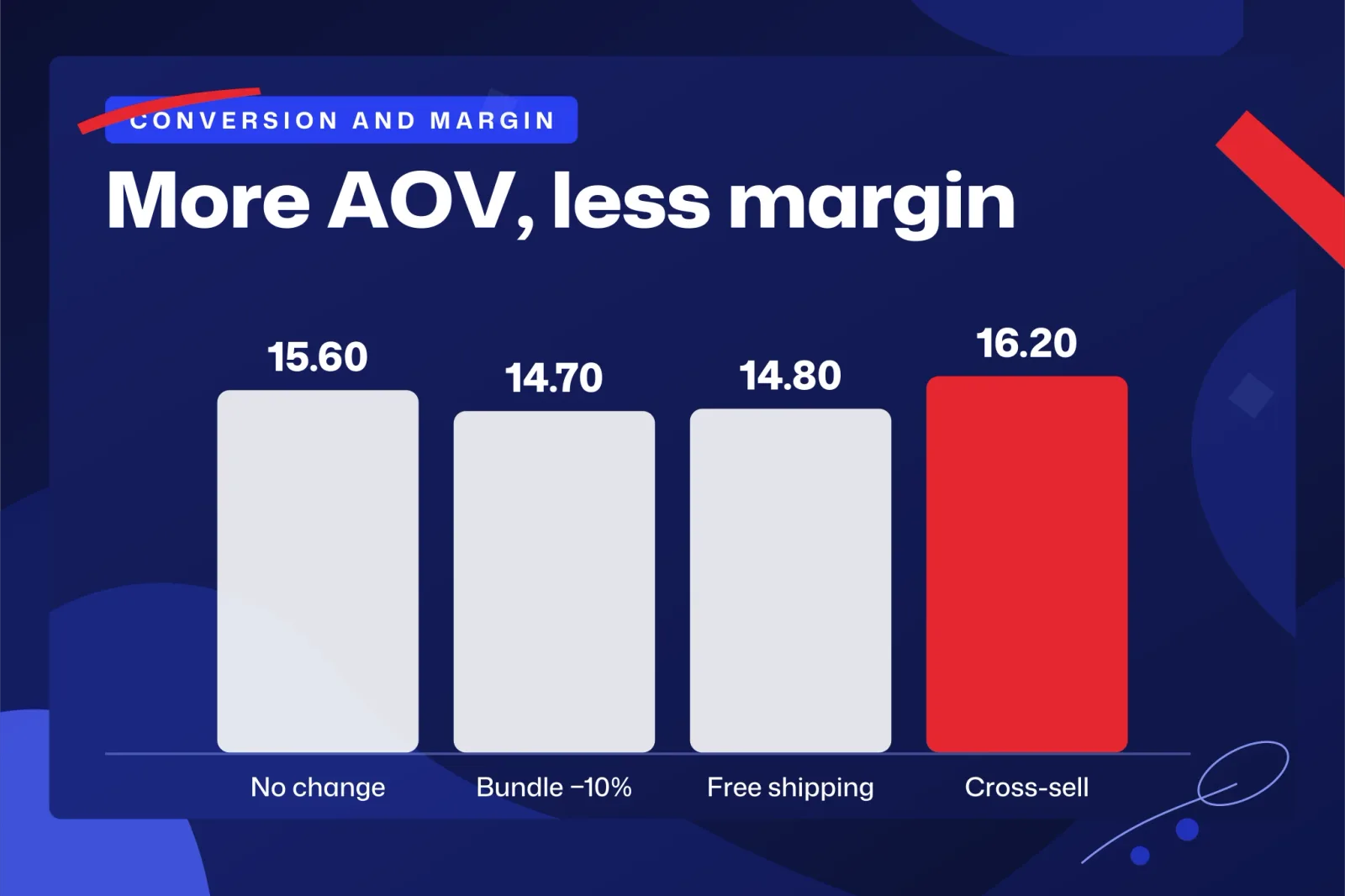
Compare total contribution, never AOV alone. In the example store, the lever that raises AOV the most loses money and the one that raises it the least is the only one that gains.
All figures in this section are invented. They are the ones from the sections above, over 1,000 orders:
| Lever | AOV | Total contribution | Contribution per order | It pays off if… |
|---|---|---|---|---|
| No change | $39.00 | $15,600 | $15.60 | Starting point |
| 2-bundle at −10% (150 switch) | $40.80 | $14,700 | $14.70 | At least 300 of the 700 one-unit orders switch |
| Free shipping from $60 (100 grow) | $42.00 | $14,800 | $14.80 | At least 215 orders grow, or about 67 new orders arrive |
| $15 cross-sell at 8% | $40.20 | $16,200 | $16.20 | Always, as long as recommending it has no cost of its own |
| Cross-sell at −20% with 12% | $40.44 | $16,140 | $16.14 | The attach rate reaches 13.3% |
Template for working it out with your store
You need six data points, most of them from an order export:
| Data point | How to get it | For which lever |
|---|---|---|
| Contribution margin (m) | (price − product cost, fees and packaging) / price | Bundle and free shipping |
| Cost of one shipment (e) | What the carrier bills you per order | Free shipping |
| Orders that already carry k units (N_k) | Order export | Bundle |
| Orders that already exceed the threshold (N) | Order export, by product amount | Free shipping |
| Current attach rate (a) | Orders with the recommended product / total orders | Cross-sell |
| Margin of the recommended product (m_q) | Same as m | Cross-sell |
- Bundle: check that δ < m·(k−1)/k. Then check that X × (k·p·(m−δ) − p·m) exceeds N_k × δ·k·p, where X is the number of one-unit orders you expect to switch to the bundle.
- Free shipping: check that X ≥ N·e / (c − e). If you fall short, work out how many new orders you would need: net loss / contribution per new order.
- Cross-sell with a discount: check that the expected attach rate exceeds a·m_q / (m_q − d).
If a lever only pays off with a figure you have never seen in your store, such as a third of orders changing behavior, treat it as a no.
What can't average order value do for your store?
AOV raises what each customer spends, but it does not bring in a single extra customer. The three levers work on people who have already reached your store with the intention of buying. What an AOV that rises with more contribution per order does give you is room to acquire: you can pay more for each new customer without losing money, as worked out in how much you can spend to acquire a customer.
If what you lack is customers, the route that does not depend on more advertising is that the ones you already have bring others. The math is in how referral marketing works and in the word of mouth marketing strategy. Tuko works there: it is an app that adds a group-buy button to the product page, and the lower price only applies if one more person joins, so nobody gets it without bringing in another customer. A bundle makes one customer buy more units; Tuko makes more customers arrive, and the two are compatible. Tuko is not a tool for raising AOV, because each order in the group carries its discount: its math is the cost of a new customer. If you want to see how it differs from a coupon portal, it is explained in what group buying is and how it differs from Groupon.
Frequently asked questions
Does free shipping count toward Shopify's average order value?
No. Shopify calculates AOV as gross sales minus discounts, divided by the number of orders, without shipping or taxes, according to Shopify's help page on the sales report. Giving shipping away does not change the AOV you see in the report, but it does change what you keep from each order.
Does a bundle discount count toward the free shipping threshold?
Shopify does not spell this out for bundles, so check it in your store. What Shopify's help page on free shipping does say is that, in the automatic discount, the minimum counts product prices only and that, with combinable discounts, each product counts at its discounted price. Our reading is that the cautious assumption is that the bundle counts at its discounted price: a $54 bundle, for example, would fall below a $60 threshold that the same products bought separately do reach. Before combining a bundle with free shipping, place a test order with the bundle and see whether it applies.
Is it worth raising average order value if total margin falls?
Almost never. It only makes sense if what you lose per order is recovered by something you can measure, such as more orders, and the formula for the new orders needed tells you how many. If you cannot check it, you are paying to see a higher number in a report.
Before switching on any of the three levers, pull from your last few months of orders your contribution margin, your real shipping cost and how many orders already carry two units or exceed the threshold you are considering, and run the three conditions in the template. If, after doing the math, what you lack is customers and not spend per order, you can install Tuko from the Shopify App Store in about two minutes, without touching your theme.