Growing a Small Beauty Brand Without Giving Away Your Margin
For a small beauty brand, growth creates a familiar problem.
You need more customers.
But one of the easiest ways to attract attention is also one of the easiest ways to reduce your margin: discounts.
10% off.
20% off.
Free shipping.
Another promotion next month.
Discounting can generate short-term interest, but for an independent beauty brand, constantly lowering the price is not necessarily a sustainable growth strategy.
So what alternatives are there?
Start with a reason, not just a discount
A promotion works better when there is a clear reason behind it.
Instead of simply reducing a product from €40 to €30, a brand can build a promotion around a specific objective.
For example:
- A product needs to reach a certain sales volume.
- A launch has a defined time window.
- A particular product needs additional visibility.
- A community campaign is built around a specific product.
The difference is subtle but important.
The question changes from:
“How much should we discount?”
to:
“What needs to happen for us to offer this price?”
That can lead to more controlled promotional strategies.
Certification can communicate value without reducing price
Price is not the only thing that defines a beauty product.
For natural and organic cosmetics, consumers may also want to understand the ingredients, formulation and claims associated with a product.
This is where certification can play a role.
NATRUE has developed a voluntary international standard for natural and organic cosmetics. Its criteria establish requirements for ingredients, their origin and processing, formulation and other characteristics of certified products. (NATRUE)
The products are independently assessed by NATRUE Approved Certifiers rather than being certified directly by NATRUE itself. (NATRUE)
For a brand, this creates another way of communicating product characteristics.
Instead of relying exclusively on marketing language, the brand can point consumers towards a defined standard and an independent verification process.
Certification does not replace a brand story.
It can strengthen the information behind it.
Community can become part of the growth strategy
Small beauty brands have something valuable: direct relationships with their customers.
A customer who discovers an independent brand may recommend it to friends, share it online or introduce it to another community.
But brands can also create mechanisms that give customers a reason to share a product.
One example is group buying.
Imagine that a brand wants to sell a defined quantity of a particular product.
Instead of simply announcing a 20% discount to everyone, the brand could create a campaign where customers join together and unlock a better price once a predefined number of purchases is reached.
The customer gets a clear incentive.
The brand gets a defined sales objective.
And the campaign creates a reason for participants to invite other people.
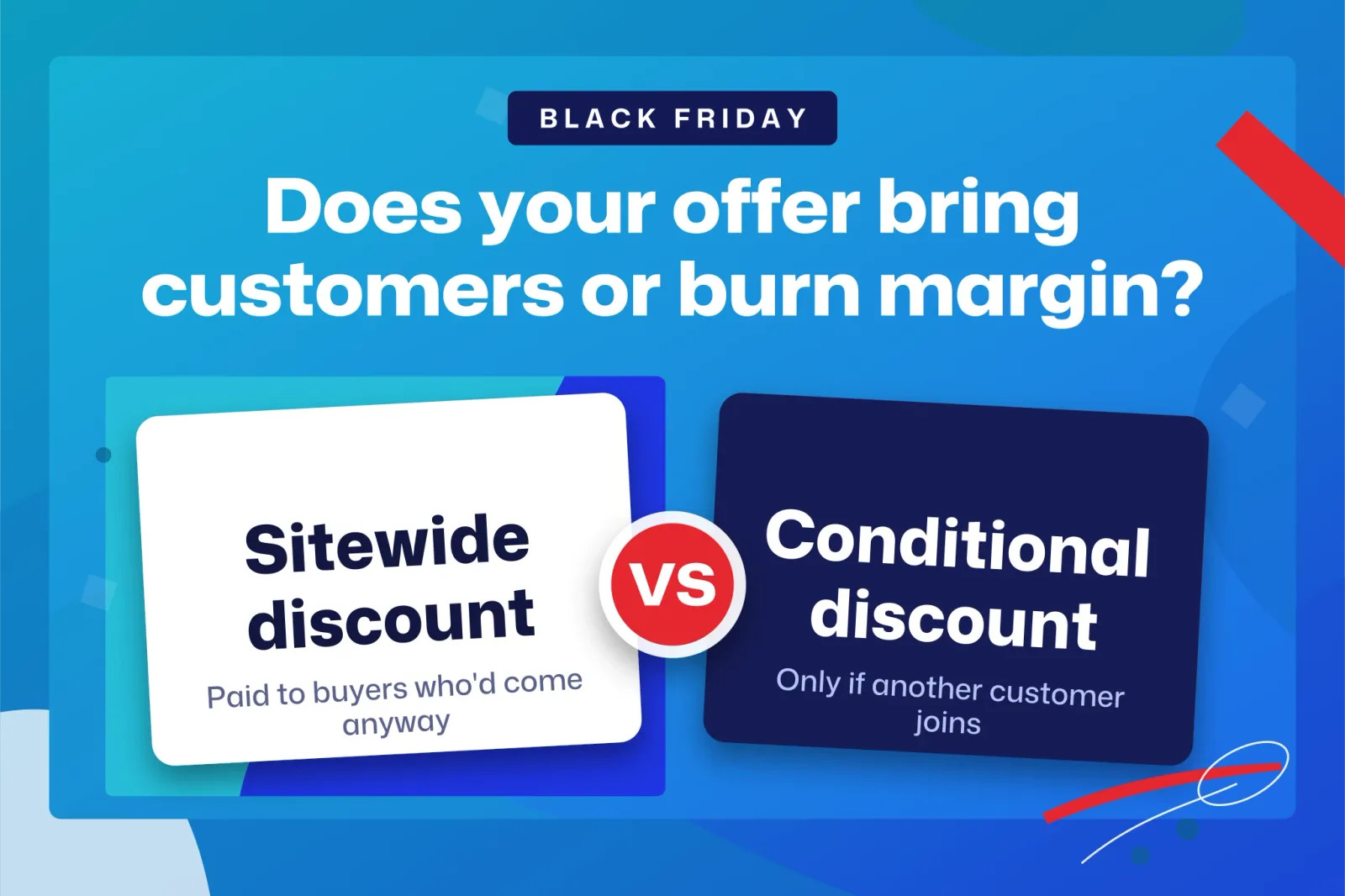
The important part is that the discount is conditional.
It is not:
“Everything is 20% off.”
It is:
“If this group reaches the agreed target, the participating customers receive the agreed price.”
That changes the role of the discount.
It becomes part of the mechanism of the campaign rather than the entire proposition.
The difference between permanent discounting and targeted promotions
Permanent discounting can create a difficult dynamic.
If customers regularly see the same products discounted, the original price can become less meaningful to them.
A targeted campaign is different.
The product, objective, discount and time period are defined in advance.
This does not mean every brand should avoid traditional promotions.
Different businesses have different margins, customers and commercial strategies.
The point is simply that a discount can be designed around a specific commercial objective rather than applied across the entire catalogue.
Certification and community solve different problems
It is useful not to confuse the two.
Certification can help answer:
“What standards does this product meet?”
Community can help answer:
“Who else is interested in this product?”
They therefore solve different parts of the customer journey.
A brand can use certification to make its product claims easier to understand.
It can use content to educate potential customers.
It can use recommendations and community to increase discovery.
And it can use targeted campaigns to give customers a reason to purchase at a particular moment.
Growth does not have to mean discounting everything
For an independent beauty brand, growth is not simply a question of acquiring as many customers as possible.
It is also about understanding what makes people choose the product, what makes them trust the brand and what gives them a reason to share it.
Certification can provide a defined framework around natural and organic claims.
Content can help consumers understand the product.
Community can extend the reach of the brand.
And targeted promotions can create a reason to buy without turning the entire catalogue into a permanent sale.
The goal is not to eliminate discounts.
It is to make them more deliberate.
Instead of asking:
“How much can we reduce the price?”
a small beauty brand can sometimes ask a more useful question:
“What can we create around this product that gives the customer a reason to buy — and gives the brand a reason to offer the price?”
That shift can open up a different way of thinking about growth.
Note: NATRUE contributed to the educational content on certification in this article. NATRUE does not endorse any specific commercial tools or services.