What is group buying? (and how it differs from Groupon)
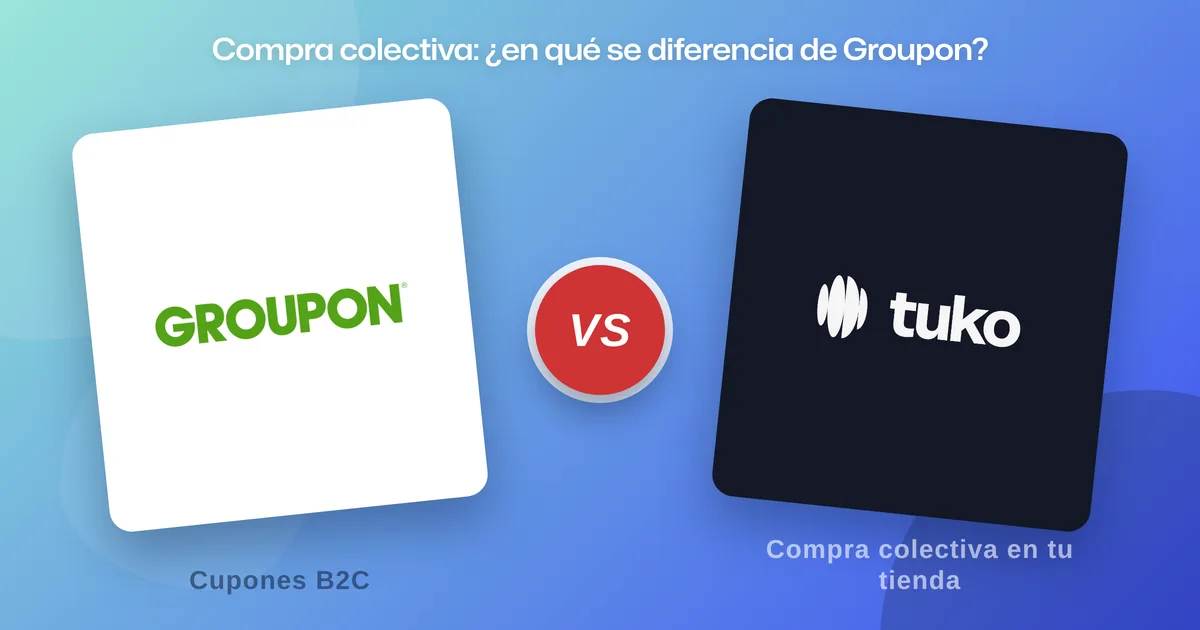
Group buying is a sales system where people join together to buy the same product — and the more people join, the bigger the discount the whole group gets. When people in Spain hear “compra colectiva”, many still think of Groupon-style coupon sites from over a decade ago: an external marketplace selling restaurant deals or getaways with steep, one-off discounts.
That is something else. Group buying on an online store is not an external coupon and not a one-time clearance cut. It is a mechanism that lives inside your own shop, on your own products, and turns every buyer into someone with a real reason to invite more people: if the group grows, the discount rises for everyone — including them.
In other words: you are not handing margin to a stranger on a coupon portal. You are letting your own customers do part of your marketing.
How group buying works in ecommerce, step by step
In its most common form, the mechanism follows four steps:
1. The store turns on group buying for a product — usually one with enough margin for a tiered discount, or stock you want to move faster.
2. A customer opens or joins a group for that product and shares the link (social, WhatsApp, email).
3. The group grows within a set time window. Each new participant moves everyone closer to the next discount tier.
4. When the window closes (or the goal is hit), the discount applies automatically to everyone who joined — no coupon codes, no support tickets.
Example with tiered discounts
A common structure is by number of participants:
People in the group. Discount applied.
5 people −5%
10 people −10%
20 people −15%
The maximum discount only unlocks if the group actually grows, so the store never gives away full margin by default — only when that discount has brought real additional sales with it.
Why group buying is growing again with social commerce
Group buying is not a one-summer fad. It is another expression of social commerce: buying with the help of other people’s recommendations and participation, not only ads. Grand View Research estimates the global social commerce market will reach USD 17,828.84 billion by 2033, with a CAGR of 37.4% from 2026 to 2033 (Grand View Research).
The reason is simple: paid ads keep getting more expensive and less reliable, so brands look for mechanisms where the buyer brings the next buyer. Group buying is one of the most direct, because the incentive to share is not “help the brand” — it is “get a better price yourself”.
Benefits of group buying for an online store
More sales without a bigger ad budget. Group growth depends on buyers inviting others. You do not need to bid higher on Meta or Google for that extra reach.
Real organic virality. People share the group because it helps them (they want the discount), not as a favour to the brand. That usually means higher share rates than classic “refer and earn” campaigns.
Clearance of slow stock. Turning on group buying for slow movers gives a concrete, time-boxed reason to buy now instead of letting inventory sit.
Margin control. Unlike a flat cut (for example −15% for everyone from minute one), a tiered discount only reaches its peak if sales volume justifies it. The store does not give away margin “just in case”.
Group buying vs other discount tactics
Tactic · Protects margin? · Creates virality? · Helps rotate stock? · Ops effort
Flat % off for everyone · Low — discount applies from the first unit · No · Yes, but no network effect · Low
Single-use coupon · Medium · No · Limited · Medium (code management)
Flash sale with countdown · Medium · Low · Yes, short term · Medium
Group buying (tiered discount) · High — discount grows only if sales grow · High — every buyer has a reason to invite · Yes, with a deadline and group effect · Low if automated with an app
How to implement group buying in your store, step by step
1. Pick the right product. Ideally one with enough margin for a 15–20% top tier, or stock you need to move.
2. Define discount tiers. You do not need steep cuts to start: a 5 / 10 / 20 people scheme is often enough.
3. Set a clear deadline. Urgency (48–72 hours, for example) is what pushes people to share instead of postpone.
4. Make sharing one click. The more friction to invite someone, the less the group grows. A direct link to social or WhatsApp makes the difference.
5. Automate the discount. The final price should apply on its own, without codes. That is what Tuko does on a Shopify store: you enable it on the chosen product and it handles group counting, discount tiers and automatic pricing — no custom development (see how Tuko works).
6. Measure real outcomes: sales generated, new buyers from sharing, and stock cleared.
Common mistakes when launching group buying
• Choosing a product with too little margin. If there is no room for the top discount tier, the campaign can get expensive.
• Skipping a deadline. Without urgency, groups stall or never complete.
• Making sharing hard. Manual link copying or forcing account creation before inviting loses people halfway.
• Not showing clearly how far the next tier is. Motivation to invite depends on seeing, in real time, how close the group is to the next discount.
Which stores it works best for
It works especially well in categories where purchase decisions are relatively fast and a “group effect” makes social sense: cosmetics, fashion and food — the three sectors Tuko focuses on today. It also performs well in any store with mid-to-low price products, high repurchase, or seasonal lines you want to move before they lose value.
FAQ
Is group buying the same as a discount coupon? No. A coupon applies the same for everyone who uses it. In group buying, the discount depends on how many people join, so the customer has an active reason to invite others.
Do I need to code anything to set up group buying? Not if you use an app built for it. On Shopify, tools like Tuko let you enable group buying on a product without custom development.
Does group buying work in every category? It works best when the product is affordable and the purchase decision is relatively fast. In highly considered or very high-price categories, the group effect is weaker.
How much discount should I offer? It depends on product margin. A progressive scheme (for example 5/10/15%) lets you start with a low commitment and raise it only if the group really grows.
Group buying is not a new tactic, but it is one of the few that can solve three typical online-store problems at once: growing dependence on paid ads, slow-moving stock, and flat discounts that hurt margin. Done well, it turns every buyer into an acquisition channel.
If you want to apply it in your store without building from scratch, see how Tuko works on Shopify. And if you need to clear stuck inventory right now, our article on clearing slow stock without killing margin goes deeper on using this exact mechanism for that goal.
See how Tuko works in your store → www.tukoteam.com